
14 November 2026 edition — Red November continues. With six weeks to the finish, the field faces another wave of losses.
The finish line is getting closer, but the weather is not improving. After an already difficult first week of November, thirteen of the fourteen assets in our Crypto Race are down. LAVA is the only one in the green, while Ethereum and Gnosis record the sharpest weekly declines.
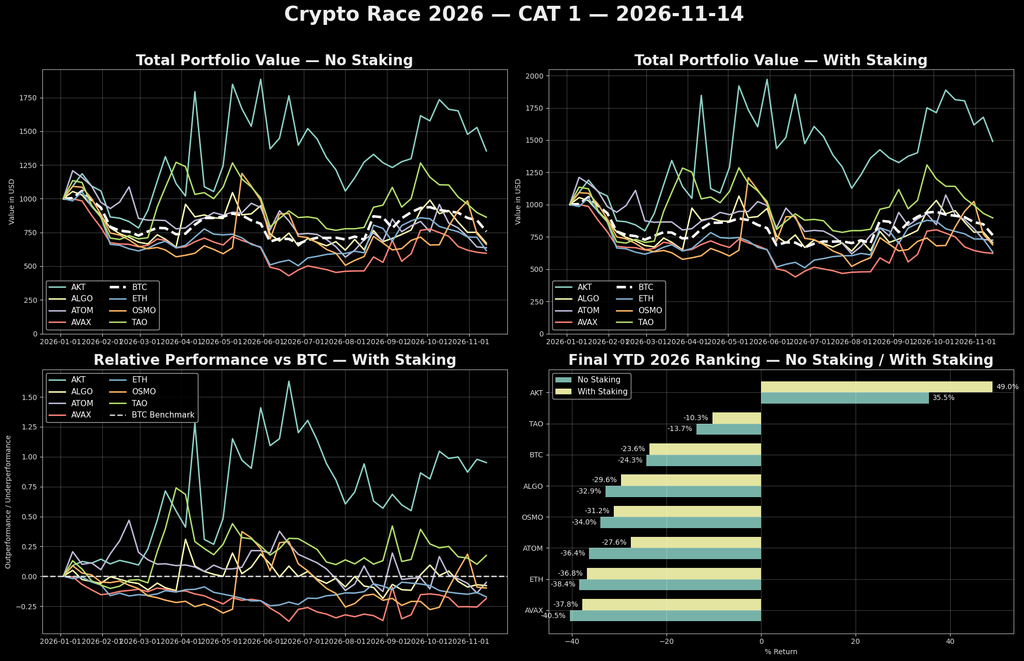
At the top of Category 1, Akash retains a comfortable lead but loses ground. In Category 2, Nolus proves more resilient and reclaims first place from Gnosis in the staking scenario. Further down the field, ATOM limits its losses and moves up the rankings.
With six weeks to go, every decline weighs on the final result. And moving up a place does not necessarily mean a portfolio has gained value.
Category 1: Akash slows, Ethereum slides
Last week, Akash was one of the few bright spots. This time, AKT falls 11.37%, from $0.6405 to $0.5677. Its lead remains substantial: it is still up 35.48% since the start without staking, and 48.34% with staking.
Akash therefore remains the only asset in positive territory among all fourteen competitors, under both scenarios. But first place offers no protection from volatility. The initial $1,000 investment is now worth around $1,355 without staking, down from $1,529 at the previous snapshot. Including simulated rewards, the position is worth approximately $1,483.
Behind it, Bittensor limits its decline to 3.85% and holds second place. Bitcoin remains third despite falling 9.93% over seven days. Since January, BTC is now down 24.27% without staking. In this category, only Akash and Bittensor continue to outperform it.
The sharpest decline comes from Ethereum: down 13.81% for the week, the weakest performance among all fourteen assets tracked. ETH drops behind ATOM in the ranking without staking and moves closer to Avalanche at the bottom of the table.
| Asset | Weekly change | Since the start, without staking | Since the start, with staking |
|---|---|---|---|
| Akash — AKT | −11.37% | +35.48% | +48.34% |
| Bittensor — TAO | −3.85% | −13.72% | −10.37% |
| Bitcoin — BTC | −9.93% | −24.27% | −23.65% |
| Algorand — ALGO | −10.68% | −32.93% | −29.69% |
| Osmosis — OSMO | −10.77% | −33.95% | −31.22% |
| Cosmos Hub — ATOM | −0.94% | −36.35% | −28.12% |
| Ethereum — ETH | −13.81% | −38.45% | −36.85% |
| Avalanche — AVAX | −1.29% | −40.46% | −37.89% |
Ranked by performance since the start without staking.
ATOM holds up as Osmosis extends its slide
At −0.94%, ATOM records the smallest weekly decline in the category, ahead of Avalanche at −1.29%. After falling 10.63% the previous week, this relative stability allows it to regain places.
Without staking, ATOM overtakes Ethereum to move into sixth place. With staking, it climbs from seventh to fourth, ahead of Algorand, Osmosis and Ethereum. Its return remains negative at −28.12%, but simulated rewards make a meaningful difference to its position in the race.
For Osmosis, the picture is more difficult. After −24.86% in the previous snapshot, OSMO loses another 10.77% this week. Since 31 October, its cumulative decline has reached 32.95%. October’s rebound now feels a long way away.
Algorand, which was unchanged in the previous edition, falls 10.68%. It retains fourth place without staking but is overtaken by ATOM when yields are included.
Category 2: Nolus retakes the lead under both scenarios
Last week, the contest between Nolus and Gnosis produced two leaders: NLS narrowly held first place without staking, while GNO moved ahead with simulated yields included.
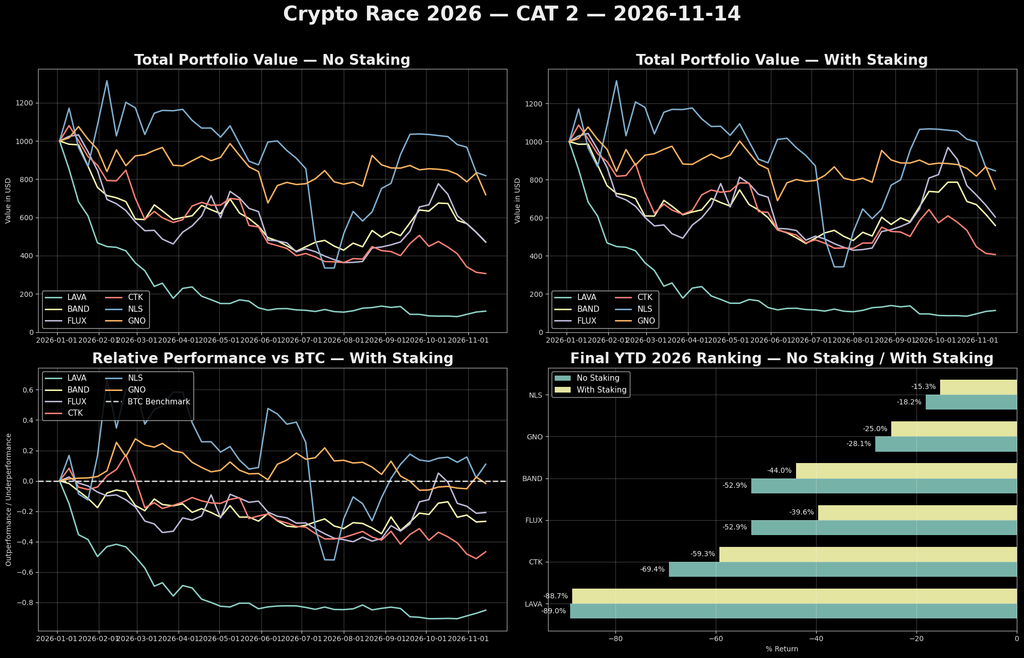
That split lasted just one week. Gnosis drops 13.68%, while Nolus limits its decline to 2.04%. NLS therefore reclaims first place with staking and strengthens its lead without it.
Since the start, Nolus is down 18.15% without staking, compared with 28.14% for Gnosis. Including simulated yields, their returns stand at −15.33% and −25.04%, respectively. Nolus also remains ahead of Bitcoin under both scenarios.
| Asset | Weekly change | Since the start, without staking | Since the start, with staking |
|---|---|---|---|
| Nolus — NLS | −2.04% | −18.15% | −15.33% |
| Gnosis — GNO | −13.68% | −28.14% | −25.04% |
| Band — BAND | −9.79% | −52.89% | −44.75% |
| Flux — FLUX | −9.86% | −52.95% | −45.23% |
| Shentu — CTK | −2.11% | −69.37% | −60.65% |
| Lava — LAVA | +4.42% | −89.04% | −88.66% |
Ranked by performance since the start without staking.
Behind the leading pair, BAND and FLUX both cross the 50% loss threshold without staking. They remain almost level: each initial $1,000 position is now worth approximately $471. With simulated yields, BAND retains a slight advantage at around $552, compared with $548 for FLUX.
Shentu holds up better this week at −2.11%, but its accumulated losses remain substantial: −69.37% since January without staking.
LAVA stands alone in the green, but remains far from break-even
LAVA gains 4.42%, recording its third consecutive weekly rise. Since the 31 October snapshot, it has gained 18.19%.
It is this edition’s only weekly bright spot. Yet it does not change the overall standings: LAVA remains last, down 89.04% since the start without staking. The initial $1,000 is still worth only around $110, or $113 with simulated rewards.
This will be an interesting trajectory to revisit in the final review. Strong gains over a few weeks can coexist with a very large loss across the full race. The starting point matters just as much as the colour of the latest move.
Staking cushions the decline without erasing the losses
At this stage, the fourteen positions represent a total initial investment of $14,000, allocated equally at the start with no rebalancing.
| Simulation | Value on 14 November | Return since the start |
|---|---|---|
| Without staking | $9,048 | −35.37% |
| With staking | $9,709 | −30.65% |
Simulated yields therefore add approximately $661, equivalent to 4.72 percentage points of performance. They provide a measurable cushion in our simulation, but are not enough to bring a second asset back into positive territory.
ATOM illustrates their effect on the rankings. Shentu shows the limits of that protection: despite a high reference APR, its position remains down 60.65% with staking. Accumulating more tokens improves the result, but their value still depends on the price at which they are measured.
Six weeks to the finish, two before the final stretch
The leaders are established, but several positions remain contested. Nolus reclaiming first place with staking and ATOM moving up the table show that the rankings can still change quickly, even during an almost entirely red week.
From the 28 November edition, we will enter the final stretch with more detailed reviews. We will take a closer look at what remains of each initial $1,000 investment, the gaps against Bitcoin and the actual contribution of rewards to the results. We will also revisit each competitor’s journey: the rebounds, the difficult weeks and the consistency of its performance.
Until then, Red November continues to wear down the field. Akash holds the lead, Nolus regains the advantage in its category, and LAVA moves against the tide. For the rest of the pack, the challenge is now to limit losses before the final turns.
Methodology
Simulation of $1,000 per asset on 3 January 2026, with no rebalancing. This edition uses snapshots dated 14 November 2026, compared with 7 November. Returns since the start cover 315 days. Weekly changes reflect prices only.
The scenario without staking tracks price movements. The staking scenario applies reference APRs in proportion to elapsed time, without compounding: BTC 0.95%, ETH 3%, AVAX 5%, ALGO 5.6%, TAO 4.5%, ATOM 15%, OSMO 4.8%, AKT 11%, LAVA 4%, BAND 20%, FLUX 19%, CTK 33%, NLS 4% and GNO 5%. The simulated value equals the value without staking multiplied by “1 + APR × 315 / 365”.
The shared label “with staking” groups together the yield assumptions used for the race; it does not mean that every asset has the same native staking mechanism. The FLUX yield used here is not a calculation of node profitability. These rates are fixed simulation assumptions, rather than a snapshot of currently available yields.