Mid-race, and the trend still hasn’t really changed
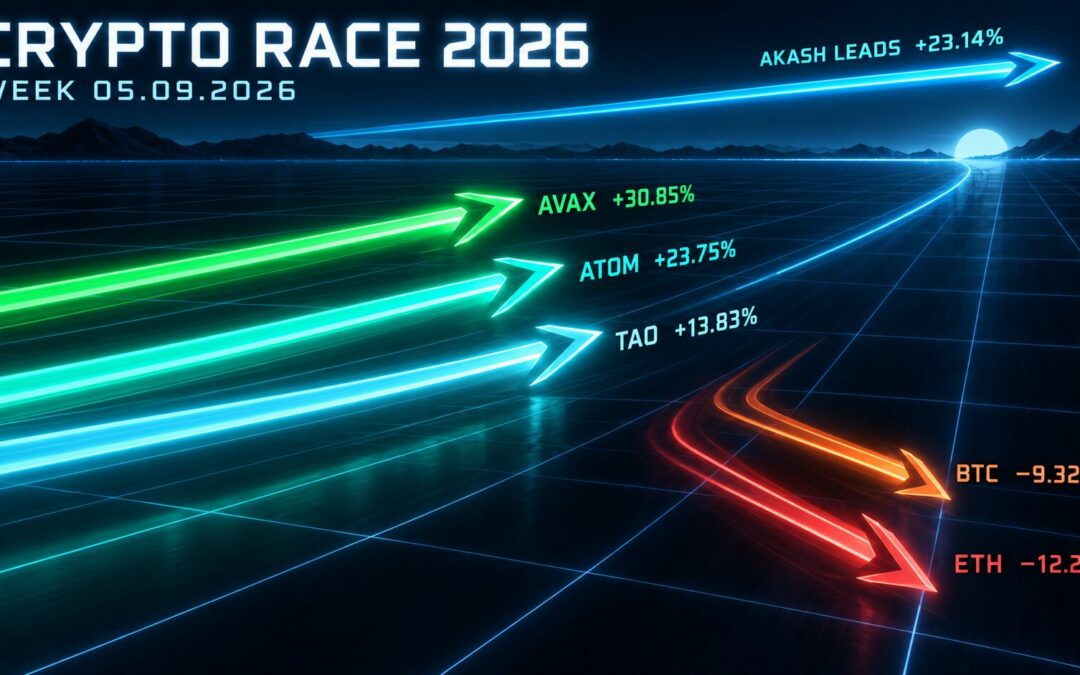
As this Crypto Race 2026 slowly approaches its halfway point, one thing remains surprisingly stable:
the overall trend of the race has not fundamentally changed yet.
Bitcoin continues acting as the benchmark of the competition.
And the central question behind this entire experiment remains exactly the same:
Can altcoins actually outperform BTC over a full market cycle once staking, volatility, and long-term endurance are taken into account?
So far, the answer appears to be both yes… and no.
Depending entirely on which assets are selected.
Important note about this Crypto Race
This race does not attempt to represent the entire crypto market.
The panel is intentionally limited to projects connected directly or indirectly to the Snow-Fall.io ecosystem:
- infrastructure projects,
- Cosmos-related networks,
- validator ecosystems,
- staking-oriented assets,
- and a few infrastructure or AI-related narratives.
Because of that, the dataset remains relatively narrow compared to the broader market.
This means the conclusions here should not be interpreted as a definitive statement about all altcoins or every crypto narrative currently active in the industry.
Instead, this race is better viewed as:
a long-term observation of whether selected infrastructure-oriented altcoins can sustainably outperform Bitcoin over time.
And at this stage of the race, the answer remains mixed.
CAT 1 — A few altcoins are still holding the pace
Several assets continue managing to outperform BTC despite the difficult market environment.
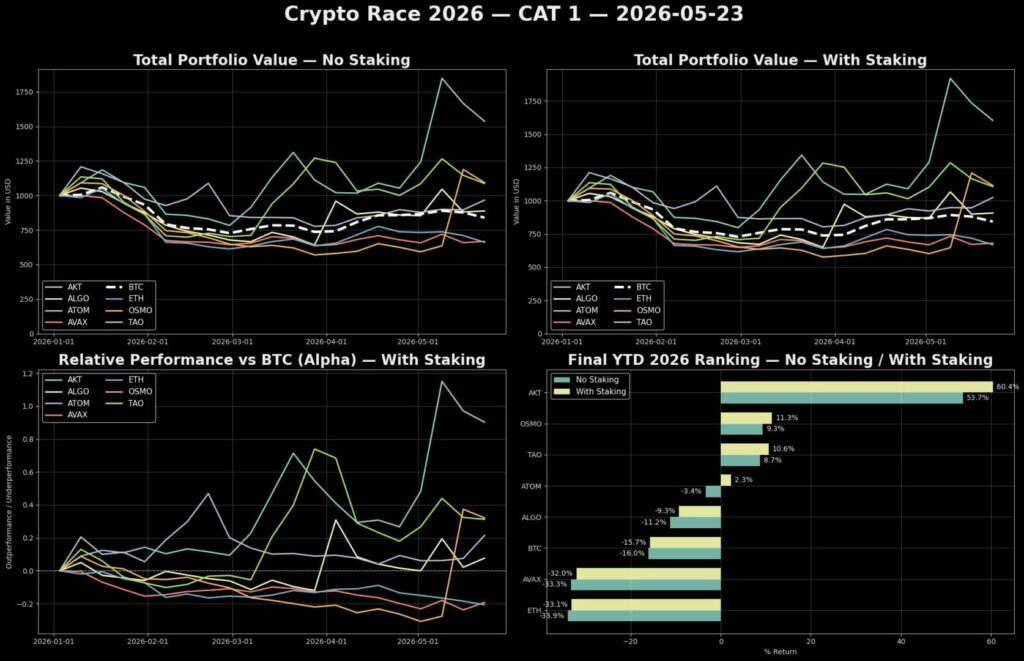
AKT remains the clearest leader of the category.
Even after recent corrections, the asset still largely dominates the overall ranking with more than +53% performance without staking and above +60% with staking included.
OSMO and TAO also continue showing strong resilience compared to the broader field.
Not through explosive pumps.
But through consistency.
And consistency becomes increasingly important in long-duration market cycles.
Meanwhile, BTC itself remains surprisingly solid considering the weakness visible across many altcoins.
The benchmark continues imposing pressure on the rest of the field.
And that pressure is exactly what makes this race interesting.
Because outperforming Bitcoin sustainably over many months remains extremely difficult for most altcoins.
Staking changes the picture… but not the reality
One of the most interesting dynamics remains the impact of staking on long-term portfolio behavior.
ATOM illustrates this effect particularly well.
Without staking, performance remains slightly negative.
With staking, the portfolio turns positive.
That difference matters.
Not because staking magically transforms weak assets into strong ones.
But because it slows down erosion during difficult periods and gradually improves long-term positioning.
This effect also appears clearly on several CAT 2 assets where staking significantly reduces drawdowns even when the underlying trend remains negative.
And this is probably one of the biggest lessons from the race so far:
staking helps portfolios survive longer,
but it does not automatically reverse market direction.
CAT 2 — The difficulty of outperforming BTC
The second category remains much more brutal overall.
Most assets continue struggling heavily against Bitcoin over the long run.
LAVA remains the most extreme example, now sitting above -83% since the beginning of the race.
CTK, BAND and FLUX continue showing how difficult it becomes for altcoins to maintain relative strength during prolonged market weakness.
Even high APRs eventually struggle against sustained price pressure.
And yet, staking still visibly improves survival metrics.
CTK moving from roughly -44% without staking to around -36% with staking becomes a meaningful gap at this stage of the race.
NLS and GNO continue acting as the most resilient assets of the category, limiting downside far better than most competitors.
What the race currently suggests
At this point, the race does not prove that “altcoins beat Bitcoin.”
Nor does it prove the opposite.
What it shows instead is something more nuanced:
A small number of altcoins can outperform BTC over meaningful periods.
But the majority still struggle to maintain that outperformance consistently across time.
And that distinction is probably where the real lesson of this Crypto Race 2026 currently sits.
Because in crypto, outperforming Bitcoin temporarily is relatively common.
Outperforming Bitcoin durably is something entirely different.
At least… for now.