Three developments this week tell three different stories about Cosmos. One affects users and their USDC. Another concerns ATOM’s ambition to reach new markets. The third shows what that ambition also demands from the people running the infrastructure when events move quickly.
USDC changes course
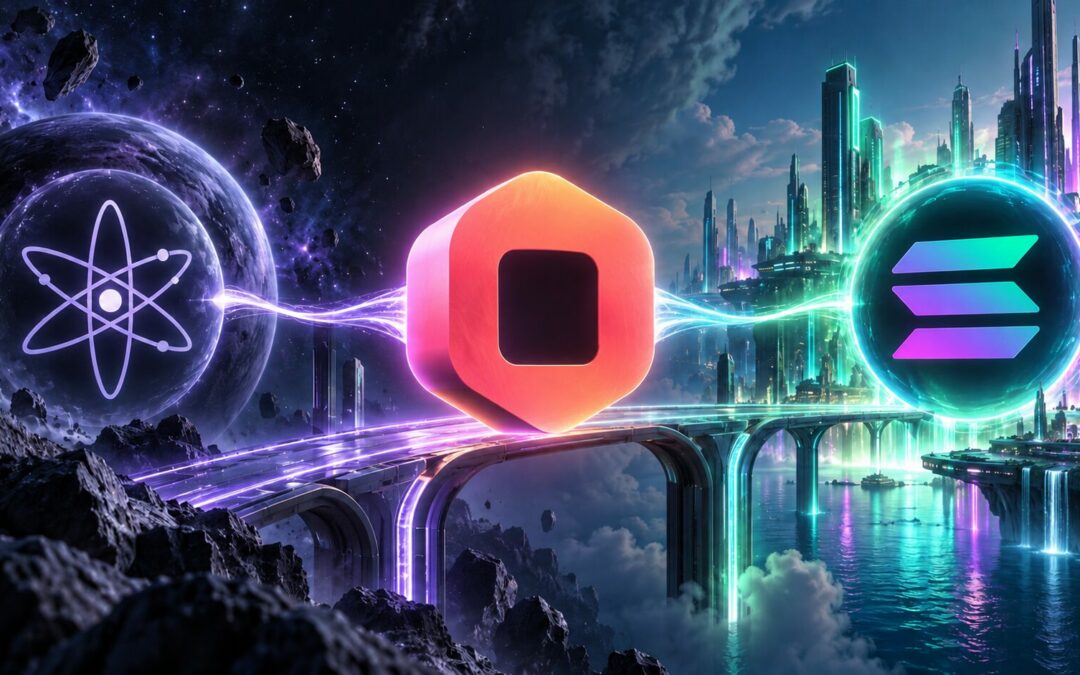
Across several Cosmos networks, USDC originating on Noble is gradually giving way to USDC originating on Injective. The difference is not obvious at first glance: both assets are called USDC. But they arrive through different routes, and applications do not necessarily treat them as the same asset.
For people still holding Noble-origin USDC on an affected network, migration is already possible. Skip Go offers a guided process that currently requires two wallet signatures. This week, Injective activated an upgrade intended to simplify that process. The new route still needs to be integrated into Skip Go: the final one-step flow is not available yet.
This is familiar territory for us at Snow-Fall. Nolus has already had to adapt its services to the changing role of USDC in Cosmos, notably by closing its Osmosis protocols tied to Noble-origin USDC. It is a reminder of something users do not always see: a stablecoin’s displayed value does not tell the whole story. Its origin, available liquidity, and the applications that continue to support it matter too.
That does not mean every Nolus user should take the same action. What to do depends on which asset they hold and where they hold it. Checking both is the sensible first step before starting a migration.
Paxos: the vote passed, but the results still need to be shown
The proposal to integrate ATOM into Paxos’s brokerage infrastructure has passed. The approved 300,740 USDC has been paid, and integration work is beginning. The goal is to make ATOM accessible, in time, to customers of platforms using that infrastructure.
Snow-Fall voted no. Our concern was not the goal, which we would like to see achieved. It was paying before a verifiable result could be presented. We had asked for stronger assurances about what would actually be delivered.
The vote has settled that decision. The useful question now is how the project progresses: what milestones will be announced, what can be verified, and when will ATOM actually become available to the intended customers? Paxos has agreed to publish progress updates. Those results will provide the basis for assessing the expenditure.
A passed proposal can open a door. It does not yet prove that anyone has walked through it.
Three upgrades in three weeks
It has also been an intense week for Cosmos Hub validators. After the governance attack on Neutron, ATOM taken from affected protocols was transferred to the Hub. Validators coordinated a temporary halt to limit further movement, then installed Gaia v28.3.0 before restarting the network.
On restart, 1,227,121 ATOM held at the attacker-linked address was moved into a multisig controlled by six validators. The funds are secured pending a recovery plan; they have not yet been returned to the affected users and protocols.
The Hub Unit noted that operators had carried out three upgrades in three weeks. These upgrades did not all have the same cause, but each required preparation and close attention. For the latest one, operators also had to stop their nodes, install the same patch, and wait for a coordinated restart signal. Snow-Fall followed that procedure.
Validators are often discussed in terms of commission rates or rankings. A week like this reveals another part of the job: being available, understanding what is changing, coordinating a response, and bringing infrastructure back online at the right time.
What comes next
These three stories are moving at different speeds. For USDC, we are waiting for the new route to become available in Skip Go. For Paxos, we are waiting for the first verifiable integration results. For the ATOM secured after the Neutron attack, we are waiting for a clear recovery plan.
All summer, across eight articles, we kept asking the same question: “Is the Hub dead?” This week does not settle every question about ATOM’s future. It does, however, offer a concrete answer to those who believe the Hub has no role left to play.
Here is what a supposedly dead project can still do: evolve, bring its validators together within hours, and protect more than a million ATOM that arrived from another network.
What happens next will be judged by results, as always. But this week, the Hub showed that it is very much alive.
Sources: Hub Unit, September 24, 2026; Skip Go migration guide.