Since the beginning of this series, we have tried to separate two things that are often mixed together: the state of Cosmos as a technology and the state of the Cosmos Hub as an economic product built around ATOM.
The hacks did not demonstrate a widespread failure of IBC. Projects leaving did not necessarily remove much value from the Hub, since some of them were barely contributing any in the first place. And ATOM’s problem increasingly appears to be less about inflation alone than about utility and value capture.
In Part 5, we therefore reached a fairly simple question: institutions are beginning to take Cosmos technology seriously, but what can ATOM actually gain from that?
Since August 13, we finally have the beginning of an answer.
Not a roadmap yet. Even less a proven economic model.
But a direction.
One Week in Korea to Choose a Direction
During the first week of August, a large part of the Cosmos Labs Ecosystem team met in Korea to work on the future product direction of the Hub.
The meeting had been planned for several weeks: after auditing the ecosystem and identifying the problems that needed to be solved, the goal was to move into the “solutions” phase. (forum.cosmos.network)
On August 13, the Hub Unit published the first conclusions from those working sessions.
Three hypotheses had been explored:
- connecting TradFi and DeFi;
- developing interoperable privacy;
- providing liquidity as a service.
One direction clearly emerged: turning the Cosmos Hub into a connection point between traditional finance and on-chain finance. (forum.cosmos.network)
The wording matters, however: Cosmos Labs still describes this direction as preliminary. Legal, technical, and commercial assumptions now need to be validated before specific products are defined. A public roadmap is currently expected by the end of September. (forum.cosmos.network)
So we now have a direction.
Not yet a product.
The Hub No Longer Necessarily Wants to Be… the Hub
This is probably the most interesting part of the announcement.
Cosmos Labs explicitly acknowledges that the Cosmos Hub is no longer necessarily trying to be the center of the Cosmos ecosystem or the single path through which interoperability must flow.
Instead, it wants to become a connection point useful enough that others actually have a reason to connect to it. (forum.cosmos.network)
That may sound like a communication nuance.
In reality, it is an important change.
For years, the very name Hub naturally suggested an architecture in which a significant part of Cosmos would eventually revolve around it.
But Cosmos evolved differently.
IBC allows chains to communicate without necessarily going through the Hub. Projects can use the Cosmos SDK, CometBFT, or IBC without directly generating revenue or utility for ATOM.
As we saw in previous episodes: the success of Cosmos does not automatically imply the economic success of the Cosmos Hub.
The new strategy finally seems to start from that reality rather than trying to fight it.
The Hub will not become important simply because it is called the Hub.
It will have to become important because it provides a service that someone actually wants to use — and pay for.
TradFi + DeFi: Where the Hub Could Find Its Place
The logic presented on August 13 is relatively straightforward.
On one side, financial institutions are beginning to tokenize assets, deposits, and financial instruments.
On the other, DeFi already has its markets, liquidity, applications, and new financial products.
But the two worlds remain difficult to connect.
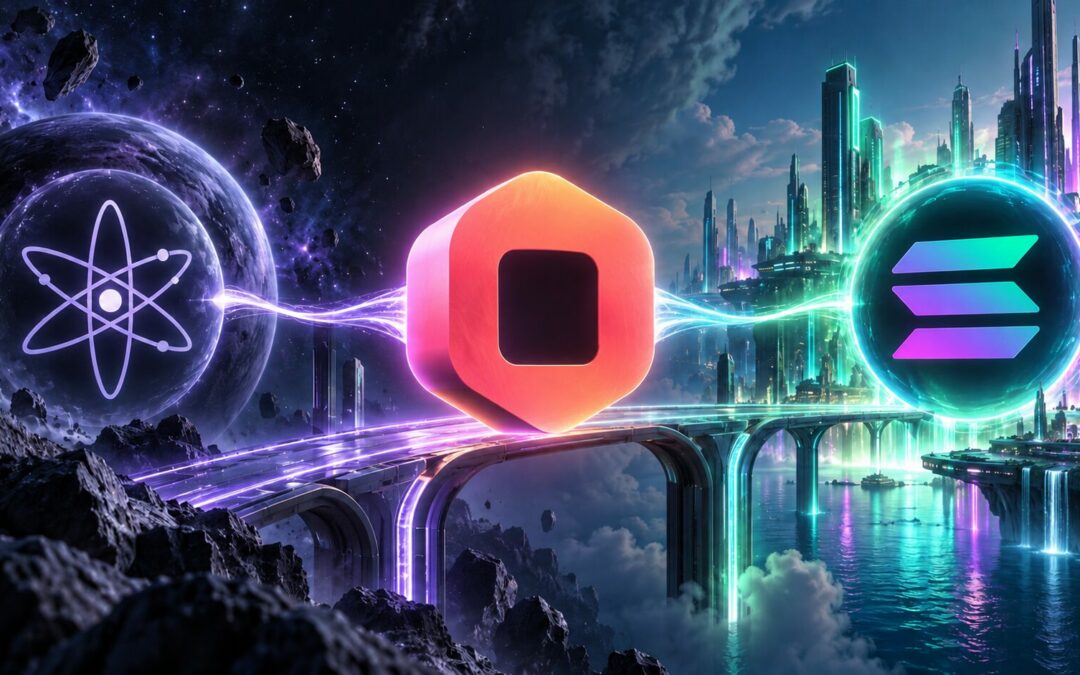
Cosmos Labs therefore envisions the Hub as infrastructure capable of facilitating the issuance, distribution, routing, or settlement of assets between these different environments.
Within this architecture, the different components would start to have clearly defined roles: IBC and Eureka for transport, Skip for routing and access, Mintscan for data, and the Hub as a layer capable of issuing, settling, routing, or aggregating certain assets and flows. (forum.cosmos.network)
This partly answers the question we raised in Part 5.
If Cosmos Labs succeeds in attracting institutions to its technology, the Hub could become the place where that activity actually meets on-chain finance.
The key word, however, remains: could.
And What About ATOM?
This is obviously where we need to remain cautious.
Infrastructure can be widely used without its token necessarily capturing much of that value.
Cosmos has already demonstrated that quite clearly.
Today, Cosmos Labs itself acknowledges that outside certain specific mechanisms — including Eureka and the USDC integration — there is still no general mechanism allowing ATOM to capture revenue from the broader Cosmos product stack. (forum.cosmos.network)
That makes the tokenomics work being conducted with Gauntlet particularly important.
Phase 1 concluded that the question should not simply be: “Should inflation be reduced?”
Phase 2 is now exploring a different logic: what can staked ATOM actually provide in exchange for its yield?
Liquidity, attestations, intent execution, securing new services… The objective would be to gradually turn stake into a productive resource used by Hub products and capable of generating revenue. (forum.cosmos.network)
On paper, that is an important shift.
Today, staked ATOM primarily secures the blockchain and receives new issuance in return.
Tomorrow, the ambition would be for part of that capital to also participate in services for which someone is actually paying.
That is precisely the economic connection that has been missing throughout this series.
But it still needs to be built.
Meanwhile, an Old Model Is Disappearing
The timing also provides a rather telling symbol.
Gaia v28 is preparing to remove the Interchain Security provider module. Following Stride’s migration away from ICS on August 4, the module no longer has an active consumer chain, and removing it will also unblock certain technical developments in Gaia. (forum.cosmos.network)
Interchain Security was once expected to become one of the major answers to ATOM’s economic utility: use the Hub’s security to secure other chains and return part of that value to stakers.
That vision did not reach the scale that had been hoped for.
At the same moment that this chapter is closing, another strategy is beginning to emerge.
That may not be a coincidence.
The Hub Is Not Saved. But the Question Is Changing.
After six episodes, we are certainly not going to declare ATOM’s problem solved because a team returned from Korea with a new presentation.
There is still no final product, no demonstrated revenue, no proof that institutions will actually use the Hub, and no definitive mechanism showing how ATOM will capture that activity.
But for the first time since the beginning of this series, we can see how Cosmos Labs intends to connect the different pieces.
Cosmos technology.
IBC.
Institutions.
DeFi.
The Cosmos Hub.
And, potentially, ATOM.
That is already an important shift from a Hub simply waiting for the success of Cosmos to somehow benefit its token naturally.
At Snow-Fall, however, our benchmark remains the same: a strategy only creates value when it eventually creates users, flows, and revenue.
And that is precisely where the next stage of our investigation begins.
For five episodes, the question was: “Why doesn’t ATOM capture more value?”
From now on, it becomes: “Can the Hub’s new strategy actually change that?”
That will be the question for Part 7.
Main Sources
Cosmos Hub — Hub Weekly Update #12, August 13, 2026
The main source for this article: conclusions from the Korea working sessions, the three hypotheses explored, the TradFi/DeFi direction, the envisioned role of the Hub, the roadmap timeline, USDC migration, and ICS deprecation. (forum.cosmos.network)
Cosmos Hub — Hub Weekly Update #11, July 23, 2026
Presentation of the roadmap-building process, the three main areas of work — RWA, interoperability, and payments — and the prior announcement of the Ecosystem team meeting in Korea during the first week of August. (forum.cosmos.network)
Cosmos Quarterly #1 — Q2 2026, July 28, 2026
Organization of Cosmos Labs around the three pillars of Ecosystem, Open Source, and Enterprise, along with updates on tokenomics, USDC integration, and preparation for the next roadmap phase. (forum.cosmos.network)
ATOM Tokenomics — Phase 1 Outcomes, July 10, 2026
Results of the Gauntlet study and, most importantly, the move toward Phase 2: exploring whether stake could do more than secure the network by also providing liquidity, attestations, intent execution, or security for new revenue-generating services. (forum.cosmos.network)