Probably somewhere in between.
Cosmos May Finally Be Rebuilding a Coherent Economic Direction
For several years, Cosmos has occupied a rather unique position within the crypto industry. The ecosystem was rarely viewed as technologically outdated. On the contrary, many of its core design choices — sovereign chains, modular architecture, and native interoperability through IBC — were often considered ahead of their time. Yet despite that technological edge, Cosmos gradually lost part of its narrative strength and economic relevance in the broader market.
The issue was never really technological. It became primarily economic and structural.
While other ecosystems concentrated liquidity, stablecoins, trading volumes, and speculative attention, Cosmos increasingly looked like a vast infrastructure layer without a clearly identifiable economic center. Activity existed. Applications existed. New chains continued launching. But the connection between all this ecosystem activity and the role of the ATOM Hub itself often remained unclear, even for part of the community.
This is precisely why the recent announcements matter far more than they initially appear to.
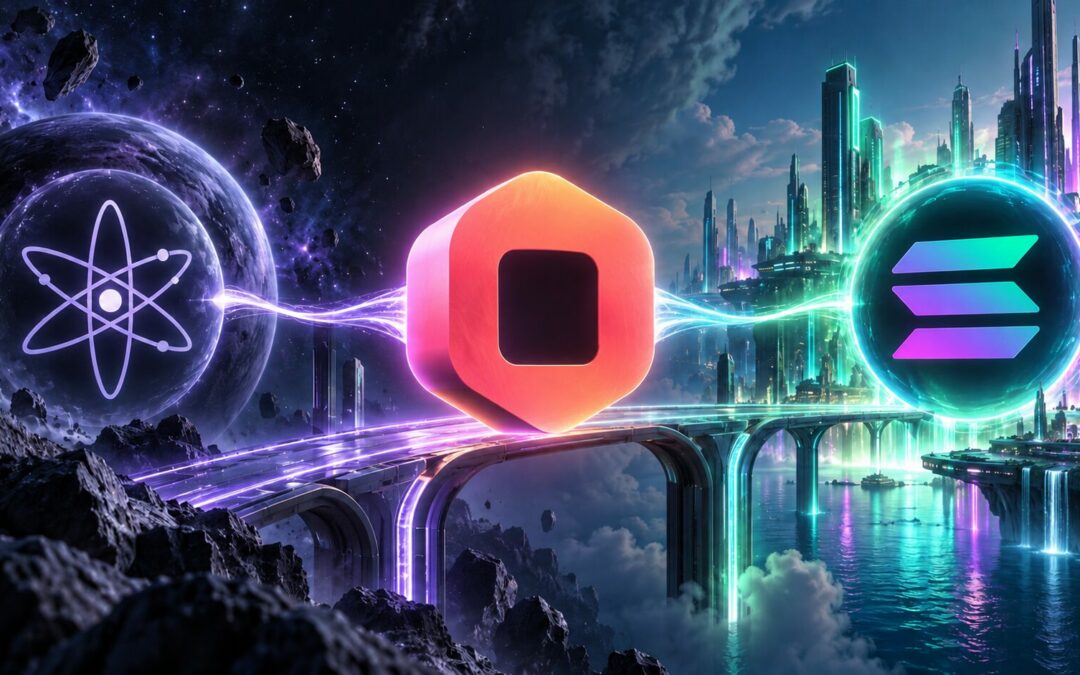
The integration of USDC through Injective is not simply another technical migration or partnership announcement. It likely reflects a broader attempt to reposition Cosmos around real financial flows, stablecoin infrastructure, and interchain payment rails.
The gradual departure of Noble toward its own EVM infrastructure created an obvious strategic vacuum. For several years, Noble had effectively become the primary gateway for USDC inside Cosmos. And in modern blockchain ecosystems, the stablecoin layer is no longer just a trading tool. It is increasingly becoming one of the central components of economic infrastructure itself. Stablecoins now sit at the center of payments, treasury flows, cross-chain settlements, financial applications, and potentially a large part of the future interaction between traditional finance and blockchain systems.
Once the long-term future of USDC support inside Cosmos became uncertain, the issue went far beyond simple liquidity concerns. Ecosystems that lose control over their stablecoin layer generally weaken their attractiveness for builders, complicate user experience, and progressively lose economic coherence over time.
The Injective agreement directly addresses this problem. A long-term IBC commitment, Skip:Go integration, Circle CCTP support, and the effort to progressively unify liquidity around a dominant USDC denomination all suggest that this is not simply about adding another asset to the ecosystem. Cosmos appears to be rebuilding a durable and coherent financial rail within its interchain architecture.
But the most important part of the announcement is probably the ATOM buyback mechanism.
For years, one of the most common criticisms directed at the Hub was relatively simple: massive amounts of activity circulated throughout Cosmos without meaningfully benefiting ATOM itself. Volumes grew across applications, stablecoins moved between chains, users interacted with IBC daily, yet the economic connection between that activity and the Hub remained weak or indirect.
The newly announced mechanism partially changes that dynamic. A portion of the revenues linked to Injective USDC activity will now be used to buy back ATOM directly on-chain. It is still far too early to estimate the real long-term impact of these buybacks on the Hub’s tokenomics. The numbers currently discussed remain modest relative to the broader market. However, the key point may not be the immediate scale of the buybacks themselves, but rather the fact that an actual economic structure is finally starting to emerge.
For the first time in a long while, Cosmos is explicitly attempting to reconnect:
economic activity → revenues → structural demand around ATOM.
And in financial systems, structures often matter far more than initial numbers. A coherent economic architecture can scale progressively alongside adoption. On the other hand, even the strongest narratives eventually fade when no tangible economic mechanisms support them underneath.
The buyback mechanism becomes even more interesting when viewed within a broader context. Individually, the amounts currently discussed remain relatively small. But the real significance may lie in the gradual emergence of multiple mechanisms capable of reconnecting financial flows back to ATOM itself.
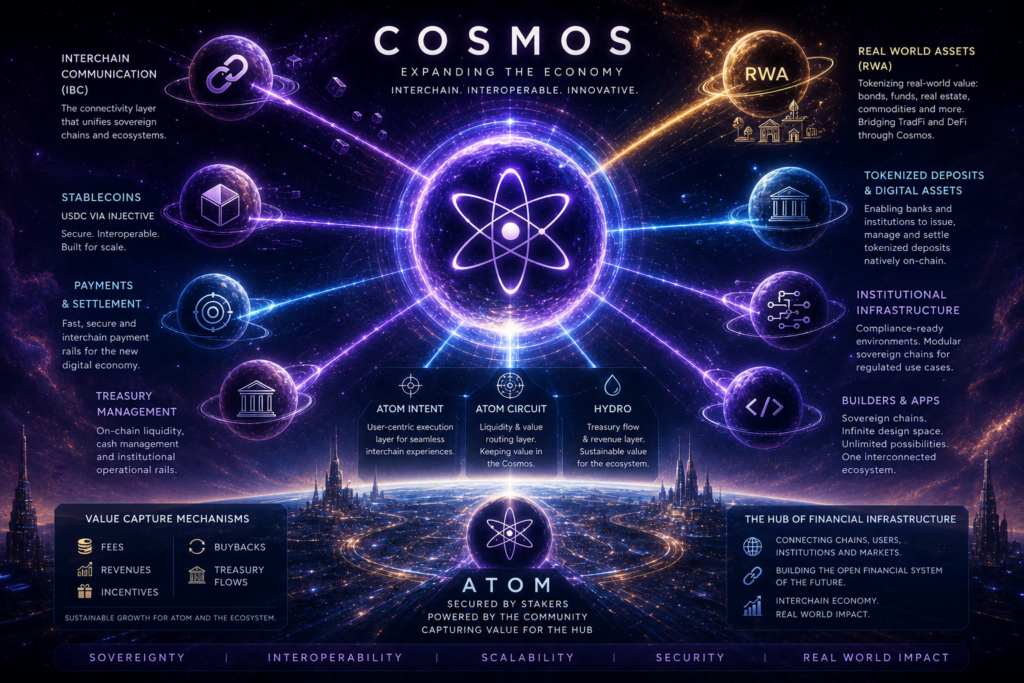
Over the past months, several initiatives have started appearing around the Hub and its surrounding economic environment: Atom Circuit, various discussions around Hydro, future intent-based mechanisms, routing infrastructure, and new stablecoin frameworks. Individually, none of these elements appear revolutionary. Yet collectively, they begin to outline a far more coherent economic direction than Cosmos previously had.
Financial infrastructures rarely derive value purely from their present activity. They often derive value because the infrastructure already exists when financial flows eventually return. If Cosmos manages to regain significant activity around stablecoins, interchain payments, treasury flows, or interoperable DeFi over time, then these different mechanisms could start producing cumulative effects far larger than current metrics might suggest.
For years, Cosmos mostly had the technology. Today, the ecosystem increasingly appears to be trying to build something else: economic loops capable of reconnecting infrastructure, liquidity, and value capture around the Hub itself.
This repositioning is also becoming visible in Cosmos’ broader communication strategy. Historically, the ecosystem primarily communicated around infrastructure-focused topics such as modularity, sovereignty, appchains, network architecture, and interoperability. These were powerful technical concepts, but often difficult to translate into an economic narrative understandable to the broader market.
Over the past weeks, however, the language has started to evolve. When Cosmos now speaks about tokenized bank deposits, treasury management, payment infrastructure, and enterprise financial systems, it likely reflects a much broader strategic repositioning. The conversation appears to be shifting away from purely technical architecture toward financial infrastructure.
And this shift is probably not happening by accident.
The current crypto market increasingly rewards systems capable of generating:
- real financial flows,
- concrete utility,
- strong stablecoin infrastructure,
- identifiable revenue mechanisms,
- and enterprise-compatible financial rails.
Within that environment, Cosmos may ultimately hold a stronger position than many currently assume. Unlike highly centralized or monolithic architectures, Cosmos’ historical design philosophy remains particularly well suited for environments where multiple actors want to preserve technical sovereignty while remaining interoperable. For enterprises, institutions, and even banking infrastructure providers, that flexibility could become far more valuable than simply maximizing raw transaction throughput.
The recent feedback requests issued by several Cosmos ecosystem participants point in the same direction. The fact that the Cosmos Foundation and various ecosystem actors are now actively asking what should be communicated better, which subjects deserve deeper analysis, and which experts should speak more publicly suggests that part of the ecosystem has realized the current battle is no longer purely technological.
Building good infrastructure is no longer enough.
Projects must now explain:
- what their infrastructure enables,
- which financial flows it captures,
- which problems it solves,
- and why it remains relevant in a much more mature market environment.
For a long time, Cosmos sometimes appeared to be building massive amounts of infrastructure without producing a sufficiently clear economic direction for outside observers. Today, several elements finally seem to be converging: stablecoins, interchain payments, buybacks, liquidity routing, treasury management, and communication increasingly centered around real-world usage.
None of this guarantees success, of course. Cosmos’ main challenge remains fragmentation — fragmentation of liquidity, applications, communities, and narratives. The ecosystem still needs to prove its ability to simplify user experience, deepen liquidity, and remain competitive against more commercially aggressive ecosystems.
But for the first time in a long while, many of the recent initiatives seem to be telling the same story.
And in an ecosystem as vast and distributed as Cosmos, that regained coherence may already be a meaningful signal in itself