🎄
Date: December 25, 2025
Author: klendhaar (Snow-Fall Validator | Active Set #171)
Part 1: The Health Bulletin (For All Cosmonauts)
This section is for all ATOM holders. No complex jargon, just the truth about the situation and the plan to fix it.
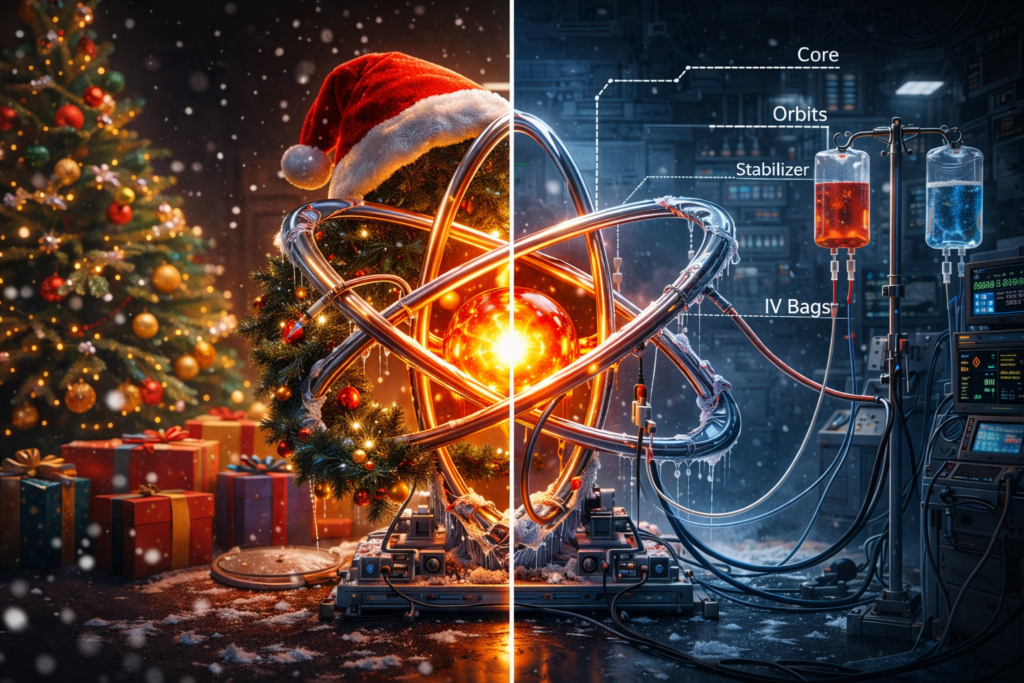
🚑 The Patient is in ER, but the Surgeon is Here
Merry Christmas to all crypto guys & girls. On this December 25th, 2025, as we look at our portfolios, it’s time to be honest: ATOM is a patient in critical condition.
I’ve spent the past few days sifting through hundreds of messages, from the noise on Telegram to the surgical analyses on the Forum. The diagnosis is simple: the heart is still beating, but the patient is bleeding out. Inflation is diluting your value, and current revenues are not enough to compensate.
But don’t panic. A clear diagnosis is the first step to recovery. Here is the 4-step rescue plan we must demand for 2026:
1. 💉 The Transfusion (Immediate)
The Interchain Foundation (ICF) must use its Bitcoin and Ethereum reserves to buy back ATOM. This is the only “fresh blood” capable of stabilizing the patient now.
Why? The ICF holds hundreds of millions of dollars in non-ATOM assets. This treasury is sitting idle when it could create a buy wall to absorb sell pressure.
2. 🩹 The Tapering (Medium Term)
We will reduce inflation, but gently. No brutal shock that would kill the patient, but a programmed decrease month after month to restore a healthy economy.
Why? A sudden cut in inflation would create panic. Stakers would leave en masse, causing a crash. The solution: a gradual and predictable reduction.
3. 🔧 The Rehabilitation (The Tech)
Activate real fees on the network. Even if it’s little at first, it proves the machine works.
Why? It’s a strong psychological signal. It shows the market that “Cosmos is handling its shit.” When volume returns (100x in a Bull Run), the pipes will already be in place.
4. 🏢 The Discharge (The Future)
Stop selling “technology” and start selling “products” to businesses. That’s where the real money is.
Why? 200+ blockchains use the Cosmos SDK for free. Banks, governments, institutions pay millions to build on it. It’s time to capture that value.
📊 Visual Summary of the Plan
| Phase | Action | Timeline | Objective |
|---|---|---|---|
| Emergency | ICF buys ATOM with BTC/ETH | Immediate | Stop the bleeding |
| Stabilization | Progressive inflation reduction | 12-18 months | Avoid shock, restore confidence |
| Infrastructure | Activate IBC fees | 90 days | Signal competence |
| Growth | B2B Model + Simplified UX | 6-18 months | External capital injection |
💬 In Summary
We stabilize the bleeding today so we can run the marathon tomorrow.
2026 must be the year ATOM wakes up.
— Technical Cut-Off – For those who want to see under the hood —
Part 2: The Surgical Protocol (Deep Dive)
This section synthesizes the technical debates among key stakeholders (Jack Chan on Telegram, Drooo and Gregory_C on the Forum, and dev teams). This is where precision mechanics are played out.
🔬 Context of Analysis
I’ve spent the past few days synthesizing fragmented discussions across multiple platforms (Telegram, Cosmos Forum, GitHub). This fragmentation hinders our ability to produce concrete proposals.
Meta-observation: We would benefit from a centralized document with moderation to prevent valuable ideas from getting lost in the noise. But for now, here is my synthesis.
1. The Mathematical Analysis: Why IBC Fees Are Not (Yet) Enough
We must face the numbers presented by Jack Chan (Telegram, December 24, 2025).
Raw Figures:
- Current revenue from IBC fees: ~$600,000/year
- ATOM inflation (10%): ~$40,000,000/year in sell pressure
The Ratio: IBC fees currently offset 0.15% of the dilution.
The Diagnosis: Relying on IBC fees to counter inflation today is like trying to put out a fire with a water pistol. The Structural Problem (Jack Chan):
“We’re moving crypto value in circles, not creating external demand. Closed system can’t create net energy.”
We are in a closed system where we recycle internal liquidity without creating net energy. Money circulates between Cosmos chains, but no fresh capital enters the system.
The Identified Solution:
We need external money (USD from businesses/institutions building on Cosmos SDK). This is the only way to inject real new buying pressure.
- Current IBC fees TAM: $600k
- B2B market TAM (businesses + institutions): +$200 Billion
2. Phase 1: External Liquidity Injection (The Role of the ICF)
Since internal revenues are currently insufficient, survival depends on external capital inflow.
The Target: The Interchain Foundation (ICF) treasury.
ICF Context:
- Non-profit organization (Switzerland)
- Holds hundreds of millions of dollars in assets (ATOM, BTC, ETH)
- Funds the development of the Cosmos ecosystem
Proposed Action:
Strategic diversification of the ICF treasury: progressive sale of BTC/ETH to buy back ATOM at a fixed, non-discretionary rate.
The Objective:
To create a non-speculative buy wall to absorb structural sell pressure while the economic model pivots.
Why this is critical:
This is the only sufficiently powerful leverage available immediately. Other solutions (IBC fees, B2B model) will take months/years to deploy.
3. Phase 2: The “Tapering” Theory (Response to Drooo)
On the forum, Drooo raised a critical medical point: the principle Primum non nocere (First, do no harm).
The Identified Risk:
Many validators and stakers have complex strategies (Delta-Neutral: they hedge their ATOM position and sell rewards as “free money”).
If we abruptly cut inflation to 0% or impose aggressive vesting overnight, we risk hypovolemic shock: a massive capital outflow and a price crash.
Drooo’s Quote:
“Adjusting inflation rates is popular and important but it should be done on a schedule instead of all at once because yes, the patient is critical but ‘First, do no harm’ still applies.”
The Snow-Fall Solution: Programmatic Tapering
Instead of an abrupt cut, we propose an algorithmic reduction of inflation (example: -0.5% per month over 18 months).
Advantages:
- ✅ Predictability: Financial markets hate uncertainty. A clear schedule reassures.
- ✅ Adaptation: Gives economic actors time to reposition their strategies.
- ✅ Smooth Transition: Avoids abrupt shock while clearly signaling the end of the high-inflation era.
Expected Result:
A controlled transition to a “Real Yield” model (real revenues > inflation).
4. Phase 3: Value Capture and Infrastructure (IBC Fees + Dashboard)
On Activating IBC Fees:
Even if the current ~$600k/year is symbolic compared to $40M/year in inflation, activating the mechanism now is strategic.
Why?
- Psychological Signal: It proves to the market that “Cosmos handles its shit” (Drooo’s quote).
- Preparation: When volume goes 100x in a Bull Run, the pipes will already be in place to capture that value.
- Principle: You build the aqueduct before the rain comes.
Transparency Dashboard (Gregory_C’s Proposal):
Implementation of a real-time public dashboard:
- Real cost of network security
- Real incoming revenue
- Required residual issuance
Proposed Mechanical Formula:
Required_Issuance = Max(0, Security_Cost - Real_Revenue)
This transparency allows for data-driven governance, not emotion-driven.
5. Phase 4: B2B Adoption and User Experience (Intents)
The Great Pivot: From Tech to Product
How do we go from $600k in revenue to $600M? By capturing the institutional (B2B) market.
The “Red Hat” Model:
- Red Hat sells support and services on Linux (open-source)
- Cosmos must do the same: sell services and security on the Cosmos SDK
But there’s a missing link:
The Key Innovation: Atom Intents (Qclusioninc/atom-intents)
What is it?
An abstraction layer that allows users (or institutions) to express an intent (“I want to swap X for Y”) rather than managing technical complexity (gas fees, IBC channels, routing).
Why is it vital for B2B?
Institutions don’t want to:
- Manage seed phrases
- Understand IBC channels
- Pay gas fees in 15 different tokens
With Intents:
- The user expresses a simple need
- The protocol manages the complexity in the background
- ATOM becomes the invisible fuel of the operation
The Future Model:
“White Label Chains” deployed in 1 click by banks or enterprises, secured by ATOM via Consumer Chains, without technical friction.
Real-world examples:
- Figure: $9.9 Billion in tokenized credit on Provenance (Cosmos SDK)
- Ondo: Manages multi-billion dollar treasuries
- SWIFT: Experimenting on Cosmos infrastructure
The Real TAM: +$200 Billion (vs. current $600k)
6. Friction Points and Open Questions
Governance Question (My Stance):
Regarding buyback mechanisms and vaults, I asked: “Who holds the keys?”
This is not rhetorical. It is the central question of any decentralized financial system.
Acceptable Answers:
- ✅ An audited, non-upgradeable smart contract
- ✅ A mechanical system based solely on verifiable oracles
Unacceptable Answers:
- ❌ A team with a 3/5 multisig
- ❌ A discretionary system that “sells when it goes up / buys when it goes down” (that’s trading, not protocol)
Agreement with Drooo:
Any “market timing” mechanism associated with the protocol turns Cosmos into a hedge fund and undermines security, regardless of transparency.
7. Success Metrics
Open question to the community:
What is the minimum viable metric that would prove we have stabilized the patient?
My Proposal:
30 consecutive days where Net Validator Buys > Net Validator Sells.
If we cannot reach this low bar, no sophisticated licensing model will save ATOM.
Conclusion: A Call for Unity
The fragmentation of our debates (Telegram vs. Forum vs. Twitter) slows us down.
As a node operator (Snow-Fall, Active Set #171), I see brilliant ideas being lost in the noise.
For 2026, my wish is simple: Let’s centralize our forces. Let’s turn these debates into concrete governance proposals with:
- A single working document
- Clear milestones
- Identified owners
The plan is there. The patient is robust. All that’s missing is the surgeon’s will.
Merry Christmas. Make ATOM Great Again. 🎄
klendhaar – Snow-Fall Validator | Active Set #171 | Pro-decentralization, anti-fragmentation
📚 References and Links
- Cosmos Forum Thread – ATOM Tokenomics Research Kickoff
- Atom Intents – GitHub Qclusioninc
- Telegram Discussions (Cosmos Hub Governance, December 24, 2025)