For months now, a familiar narrative has been circulating in crypto circles: “Cosmos is dead.” ATOM’s price has underperformed, attention has shifted to newer narratives, and many observers reduce the health of an ecosystem to the performance of a single token.
That reading misses what is actually happening.
Cosmos is going through a strategic transition — from a retail-driven ecosystem to an infrastructure layer increasingly aligned with institutional use cases, especially around stablecoins and real-world assets (RWAs). This shift changes how value is created, how fast markets react, and how Cosmos should be evaluated.
The core misunderstanding: Cosmos is not a monolithic blockchain
Judging Cosmos solely through ATOM and comparing it directly to Ethereum or Solana overlooks its original thesis.
Cosmos was never designed to concentrate all activity on a single chain. It was built for a fragmented world: sovereign, specialized blockchains that can interoperate. Its goal is not to win the race for generic smart-contract dominance, but to provide the infrastructure layer that allows heterogeneous systems to coexist and communicate.
This distinction becomes critical as traditional finance moves on-chain.
Institutions tokenizing real-world assets do not want to depend on external governance or share blockspace with unpredictable applications. They require control, compliance, performance, and auditability. The appchain model — sovereign chains tailored to specific requirements — directly addresses those constraints.
Cosmos is not competing to issue stablecoins or dominate retail DeFi. It provides the plumbing that allows these systems to move and settle across networks.
Stablecoins: from speculation to infrastructure
Stablecoins were long viewed as simple trading tools — places to park capital between positions. That phase is ending.
They are rapidly becoming financial infrastructure:
- on-chain payment rails
- trading and credit collateral
- core DeFi building blocks
- digital treasury instruments
As their systemic role grows, a new requirement emerges: predictability. Even in high-performance DeFi ecosystems, demand is increasing for stable, understandable yields that are not driven by artificial emissions or speculative cycles.
This search for stability reflects a maturing market where stablecoins evolve from opportunistic instruments into durable infrastructure. And any financial infrastructure inevitably attracts regulation, standardization, and institutional participation.
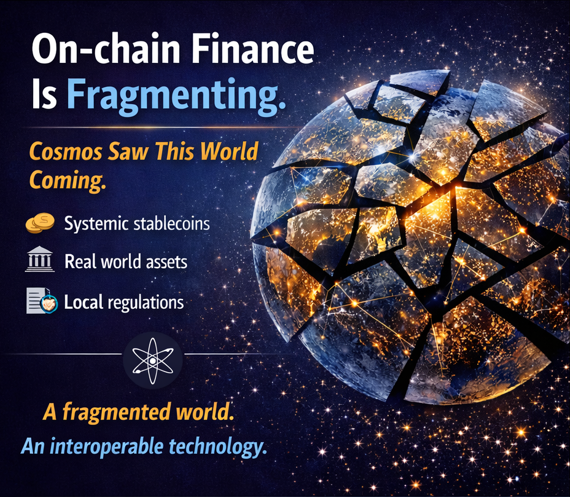
As stablecoins become central, the on-chain financial system trends toward a fragmented architecture combining regulated solutions, DeFi environments, and jurisdiction-specific rails.
Regulatory fragmentation strengthens the Cosmos thesis
Ongoing regulation around stablecoins and tokenized assets is unlikely to produce a single universal model. The more plausible outcome is structural fragmentation:
- bank-issued stablecoins
- permissioned institutional chains
- DeFi-native stablecoins
- jurisdiction-specific variants
In such an environment, the key question is no longer which chain wins, but how chains interact.
The more the system fragments, the more strategic interoperability becomes. This is precisely the problem Cosmos set out to solve from the beginning through IBC and its sovereign chain architecture. What once looked like an abstract design choice increasingly matches real financial market needs.
Case study: Ondo and the regulatory normalization of tokenized securities
A recent development illustrates this transition in concrete terms: Ondo Global Markets’ confidential filing with the U.S. Securities and Exchange Commission (SEC).
At the Ondo Summit, Ondo announced that it submitted a registration statement to provide issuer-level disclosures compliant with SEC requirements for its tokenized products. These standards are widely regarded as the global benchmark for financial market transparency.
If effective, this filing would make Ondo the first issuer of transferable tokenized securities subject to SEC reporting obligations. The objective is clear: enable on-chain circulation of financial securities while operating within the strictest regulatory frameworks.
Ondo is not merely issuing tokens. It is building a full regulatory stack that includes an SEC-registered transfer agent, broker-dealer, investment adviser, and alternative trading system (ATS) — effectively an on-chain capital markets infrastructure.
The scale is already meaningful: Ondo Global Markets exceeds $500 million in total value locked, more than $9 billion in cumulative trading volume, and serves tens of thousands of investors outside the United States, making it the largest tokenized equities platform globally.
Ondo’s case sits within a broader convergence of stablecoins and RWAs into a unified financial infrastructure. Stablecoins act as settlement rails for tokenized markets, while RWAs bring productive, regulated assets onto those rails. Together, they form the early foundation of an on-chain system capable of supporting institutional volumes.
This convergence increases both regulatory and technical fragmentation, reinforcing demand for interoperable architectures that can connect sovereign environments — a role Cosmos is specifically designed to fulfill.
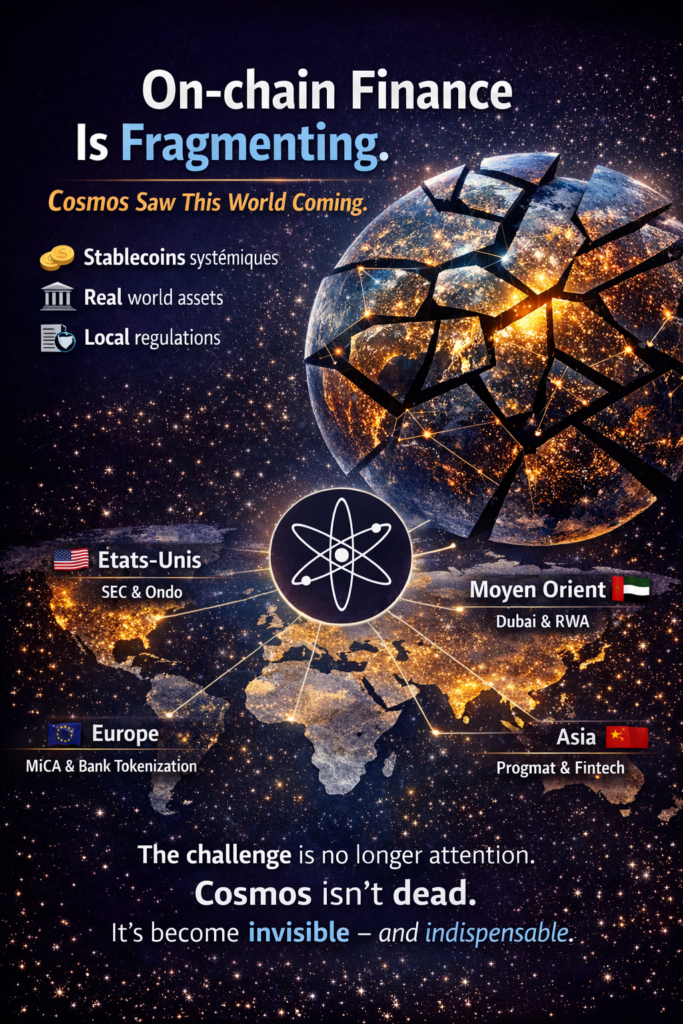
Toward a regional map of tokenization
As on-chain finance professionalizes, tokenization is not organizing around a single global center but around emerging regional hubs. The United States, the Middle East, Europe, and parts of Asia are developing their own regulatory frameworks, market infrastructures, and specialized platforms.
Ondo in the U.S. and RWA-focused projects such as MANTRA in Dubai illustrate this dynamic. Additional financial centers may join as regulatory clarity improves and institutional demand expands. Each hub builds tokenization rails aligned with its legal, economic, and strategic priorities.
In this multipolar landscape, the central question is no longer which blockchain will dominate globally, but how sovereign systems will interconnect. Tokenized finance is evolving into a network of connected jurisdictions rather than a unified ecosystem.
This is exactly where Cosmos’ architecture becomes relevant. Designed to link independent chains while preserving sovereignty, it can serve as a shared foundation between regional hubs. If institutional tokenization continues to expand geographically, the need for interoperable infrastructure connecting these markets will only increase.
The emergence of multiple tokenization centers does not weaken the Cosmos thesis — it strengthens it. The more regional, regulated, and specialized on-chain finance becomes, the greater the need for connective tissue.
The real tension: technological adoption vs ATOM value capture
Recognizing Cosmos’ technological relevance does not ignore its economic challenges.
The central issue is not Cosmos’ survival but how its adoption translates — or fails to translate — into value capture for ATOM.
Three broad trajectories are possible:
Bullish scenario. Institutional chains heavily leverage interoperability and shared security, increasing the Hub’s centrality and activity around ATOM.
Neutral scenario. Private deployments expand, but economic value remains largely internal, with limited impact on ATOM.
Hybrid scenario (most likely). Regulated stablecoins and DeFi coexist in a mixed ecosystem, driving rising demand for interoperability. Cosmos architecture gains structural importance while ATOM value capture progresses gradually.
This tension signals maturation, not decline. The ecosystem is working to align infrastructure with economic incentives.
Conclusion
Cosmos is not dead. It is mispriced.
The ecosystem is not trying to win the attention economy; it is addressing a deeper problem: how to connect a regulated, regional, and fragmented on-chain financial system. Stablecoins are evolving into systemic payment rails. Real-world assets are integrating into markets under strict institutional frameworks. Regional hubs are emerging — the United States, the Middle East, Europe, Asia — each with distinct rules and infrastructures.
In this context, the idea of a single blockchain dominating the entire system becomes increasingly implausible. Tokenized finance is not converging — it is distributing.
This is the world Cosmos anticipated: sovereign, specialized, interconnected chains where interoperability matters more than hype. The real debate is not Cosmos’ survival but how this structural adoption will translate into economic value.
If on-chain finance becomes what it is rapidly becoming — fragmented, institutional, and global — Cosmos is not behind. It is positioned exactly where infrastructure matters more than narrative.
Cosmos isn’t dead.
It is becoming invisible — and indispensable.