MANTRA is a Cosmos-SDK based project positioning itself as a blockchain specialized in Real-World Assets (RWAs) and regulated institutional finance.
While many networks discuss RWAs mostly as a narrative, MANTRA is attempting a more vertical approach: compliance-oriented infrastructure, yield products backed by traditional instruments, and a progressive buildout of a dedicated Layer-1.
This article provides a factual overview of:
- the OM → MANTRA pivot,
- the RWA building blocks already announced,
- “stable deposit” style vault use cases,
- and the potential role of such a chain within the broader Cosmos ecosystem.
1. A Structural Pivot: OM Evolves into MANTRA Chain
MANTRA has announced a major transition of its ecosystem: moving from OM toward a consolidated identity and network under the name MANTRA Chain, with a full migration planned for early March 2026.
The objective is clear: to concentrate liquidity, economic activity, and value capture on a sovereign Layer-1, rather than remaining fragmented across multiple environments.
Official source:
https://mantrachain.io/resources/announcements/mantra-chain-coin-upgrade-timeline-and-key-details/
2. A Project That Has Lived Through a Full Cycle
Despite an initially high-profile launch, OM went through a more difficult period, marked by a sharp correction and a typical loss of confidence seen across crypto market cycles.
Since then, the team appears to have continued building and repositioning, with a clearer strategic pivot toward a dedicated RWA-focused infrastructure.
3. Positioning: A Blockchain Dedicated to RWAs
MANTRA presents itself as an “RWA infrastructure chain”, meaning:
- issuance and management of tokenized real-world assets,
- an institutional and compliance-first framework,
- integration of products linked to bonds or bank deposits,
- deployment toward regulated jurisdictions.
The project documentation emphasizes this compliance-oriented approach.
General presentation:
https://mantrachain.io/
4. Regulation: Middle East Focus and VARA (Dubai)
One differentiating element frequently highlighted by MANTRA is its alignment with regulated initiatives, particularly in Dubai through VARA-related frameworks.
This reflects a broader strategy often seen in the RWA sector:
- operating within institutional-compatible legal structures,
- building on-chain rails designed for real-world issuers.
Roadmap and updates:
https://mantrachain.io/resources/announcements/roadmap-update/
5. A First Concrete Building Block: A “RWA Savings Vault” Powered by USDY
A key point is that MANTRA has moved beyond pure intention.
The network has already announced a significant product: a RWA Savings Vault, built around USDY (Ondo Finance).
USDY is a tokenized note backed by US Treasury bills and bank deposits, designed to bring traditional fixed-income style yield on-chain.
This is one of the clearest examples of what many describe as a “stable deposit” or institutional yield-bearing vault.
Official announcement:
https://mantrachain.io/resources/announcements/mantra-launches-rwa-savings-vault-powered-by-ondos-usdy/
6. Technical Context: Architecture and Product Direction
From a technical perspective, MANTRA is built as a sovereign blockchain on the Cosmos SDK, with a stated objective of expanding its execution compatibility, including EVM-style environments.
The goal is to combine:
- Cosmos modularity and interoperability (IBC),
- a developer surface familiar to DeFi builders,
- and infrastructure rails oriented toward regulated assets (vaults, tokenized deposits, institutional-grade products).
In this context, validator set quality and governance participation become structural: the credibility of an “institutional” chain also depends on the stability and seriousness of its validator foundation.
7. Why an RWA Chain Can Matter Within Cosmos
Within Cosmos, specialization is the norm:
- DeFi hubs (Osmosis),
- stablecoin infrastructure (Noble),
- data availability layers (Celestia),
- and potentially RWAs (MANTRA).
The modular and sovereign design of the Cosmos SDK makes this type of verticalization possible.
A dedicated RWA Layer-1 could serve as an interoperable asset hub via IBC, connecting:
- institutional vaults,
- tokenized collateral,
- stable liquidity,
- and broader interchain DeFi applications.
8. The Structural Question: Cosmos Wins… But Where Does ATOM Sit?
Chains like MANTRA strengthen the Interchain thesis: Cosmos infrastructure continues to attract entire financial verticals.
But it also raises a recurring question:
if each appchain captures its own revenues, liquidity, and asset flows, how does ATOM capture value at the network-wide level?
MANTRA does not provide a direct answer, but it illustrates a consistent dynamic:
- Cosmos as a stack works,
- economic value often migrates toward the zones themselves.
Note: Snow-Fall Joins the Active Validator Set
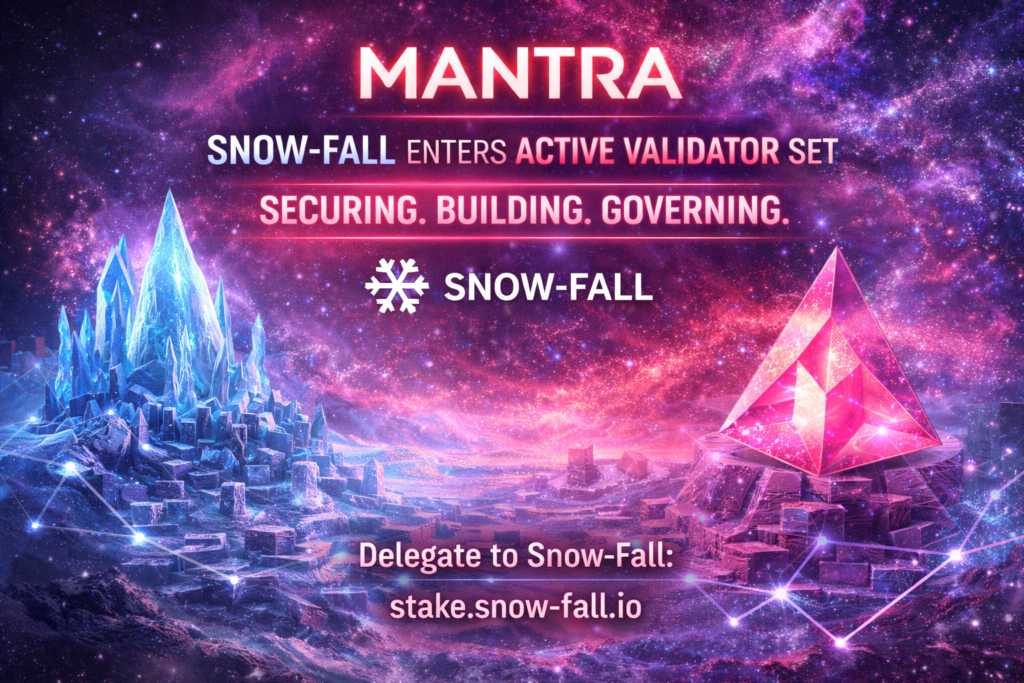
This morning, Snow-Fall entered MANTRA’s active validator set.
In a Proof-of-Stake network, the active set plays a central role: security, network continuity, and participation in governance decisions.
The final active set positions remain highly contested. Nothing is guaranteed, and long-term sustainability also depends on delegator support.
We hope our proven and visible involvement — both technically and in governance — will help us cross this threshold and remain a long-term contributor to the network.
Stake with Snow-Fall:
https://stake.snow-fall.io/
Conclusion
MANTRA is currently in a significant transition phase:
- consolidation OM → MANTRA Chain,
- development of a specialized RWA infrastructure,
- first announced vault products around USDY,
- and an institutional compliance-oriented strategy.
The project remains worth watching closely. Its long-term success will depend less on narrative, and more on execution: real assets onboarded, real adoption, and interchain integration.