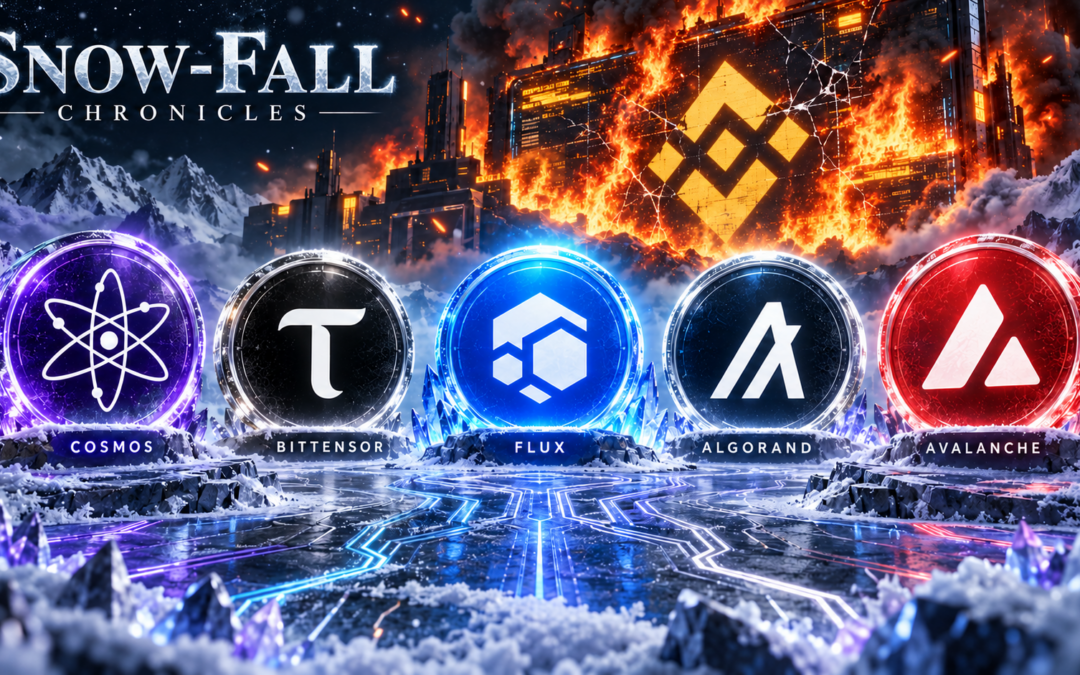
Unless you have just returned from a stay in the woods, with no signal and far from any notifications, you have probably heard about the Binance hack. It is the major story heading into the weekend, and understandably dominates much of the crypto news cycle.
We will not cover it in detail here. Other outlets and specialists have the expertise and investigative resources to report on this event far better than we can.
Our role in this chronicle is also to look at what that headline might overshadow. While attention focuses on a single story, networks continue to evolve, companies commit capital, economic models change, and teams work on long-term security.
This week, we turn to Cosmos, Bittensor, Flux, Algorand and Avalanche. There are concrete developments to discuss, alongside two broader perspectives that deserve to be distinguished from new launches.
Cosmos: Preparing for What Comes Next While Maintaining the Network
For Cosmos, the official update published on October 29 provides an important progress report: validation of the Hub’s future roadmap is complete, and the second phase of the tokenomics work has concluded. Both are now being prepared for governance review. This does not mean that a new economic model has been adopted.
That distinction matters. Defining a direction, checking its feasibility, submitting it to the community and implementing it are separate steps. For ATOM holders, the key will be understanding what is actually proposed, in what order, and with what expected effects.
Meanwhile, the network reached a concrete milestone: Gaia v29 was deployed on October 28, updating the Cosmos SDK, removing a legacy module and applying a Go runtime security patch.
This work rarely makes headlines. Yet it remains essential: a development strategy needs well-maintained infrastructure underneath it. Cosmos is therefore moving on two complementary fronts: the operational work needed today and the economic decisions that will shape its future.
Bittensor: KR1 Commits 5,000 TAO to the Network
Decentralized AI generates plenty of discussion. This week, Bittensor has something more tangible to point to.
On October 29, London-listed company KR1 announced the launch of its infrastructure operations on Bittensor, with a holding of 5,000 TAO deployed through staking. Its stated objective is to generate income while maintaining long-term exposure to the network’s development.
What makes this announcement interesting is the move from observation to financial commitment. A listed company is choosing to incorporate Bittensor into its operations and allocate capital to it.
Still, perspective matters: buying and staking TAO does not, by itself, demonstrate that the AI services offered by individual subnets have established a sustainable customer base. Investor interest and user adoption are different indicators.
It is nevertheless a concrete signal for Bittensor, in a sector where promises still occupy considerable space. The next question remains one of utility: which services will prove useful enough to keep customers coming back and paying?
Flux: Rewards Decline, Customer Revenue Becomes More Important
At Flux, this week’s news directly affects the network’s economics.
On October 26, at block 3,071,200, the first scheduled annual reward reduction took effect. The block reward fell from 14 to 12.6 FLUX, a reduction of 10%. Payments allocated to the different node tiers decreased proportionally. The transition was built into the network’s rules and required no action from operators.
For token holders, this means a slower rate of issuance. For operators, it reduces the portion of income coming from block rewards.
Both sides matter. Lower issuance can be presented positively, but the machines still need to be funded and maintained.
Flux plans to introduce its Progressive Node Rewards mechanism in July 2027, redistributing 20% of application payments to operators. That mechanism is still ahead of us.
The underlying question is therefore very practical: how much can paying demand for cloud services contribute to funding the infrastructure? Application and customer numbers, spending and retention will be important indicators to watch.
Algorand: Preparing for Security Risks Before They Become Urgent
The topic highlighted by Algorand this week looks further ahead: resistance to quantum computers.
In an October 27 publication, Algorand emphasizes the time required to migrate cryptographic systems. The article discusses planned hybrid accounts combining classical and post-quantum keys, alongside changes to developer tools and custody solutions. This is a perspective on an ongoing transition, not an announcement that comprehensive protection was deployed this week.
The idea is straightforward: an institution planning to hold digital assets for decades must also consider how long their security will remain effective.
Changing cryptography involves far more than replacing a line of code. Wallets, signing procedures, hardware and partners all need to keep pace.
That is what makes this subject worth discussing: security is also built during quiet periods, long before a vulnerability becomes an emergency. Quantum risk is, of course, a separate issue from the incidents dominating today’s headlines.
Avalanche: Tokenized Equities Beyond the Announcement
An October 28 publication brings renewed attention to Dinari’s work on Avalanche. Dinari describes an offering of more than 350 tokenized U.S. securities, including stocks, ETFs and real estate investment trusts, or REITs. According to the company, each dShare is backed by a corresponding security held in custody.
One clarification is necessary: the expansion to Avalanche’s C-Chain was announced on June 11, 2026. We are therefore discussing an existing deployment highlighted again this week, rather than a brand-new launch.
The subject remains relevant because it provides a concrete example of tokenization: representing existing financial instruments on a blockchain, supported by infrastructure for custody, distribution and the management of investor rights.
Availability does not mean that every product is accessible to everyone, everywhere. Nor does it automatically imply a benefit for the price of AVAX.
To assess the significance of this infrastructure, we will need to examine its use: participating investors, trading volumes and integration into financial services.
Keeping an Eye on What Is Being Built
Major incidents deserve the attention they receive. They should not become our only lens for understanding the ecosystem.
This week illustrates several different developments: Cosmos is preparing its next decisions, Bittensor is attracting a concrete financial commitment, Flux has reached an economic milestone, Algorand is emphasizing risk preparedness, and Avalanche continues to provide infrastructure for tokenization.
These developments are at different stages of maturity. A roadmap still needs to be implemented, an investment does not guarantee adoption, and a product catalogue does not prove commercial success.
That is precisely what we will continue to track at Snow-Fall: what is announced, what is delivered, and what ultimately gets used.