
Developing technology, attracting users and funding operations over time: the projects we follow need to make progress on all three fronts.
This week, the Cosmos Hub community call shed more light on ecosystem funding and the institutional strategy. Provenance also drew attention with a tokenized asset figure that warrants verification. Meanwhile, Flux hosting data shows measurable growth in gaming activity.
Cosmos Hub: the ICF clarifies its use of ATOM
The October 15 community call revisited the relationship between the Interchain Foundation, Cosmos Labs and the Hub. According to Tonyler’s recap, one issue was addressed directly: the perception that the foundation had been selling ATOM.
Josh Cincinnati stated that the ICF had sold no ATOM this year. The policy described is to fund operations through fiat reserves or sales of BTC and ETH.
ATOM nevertheless remains part of its operations. The foundation uses its tokens in its delegation programme and pays part of its compensation in ATOM, with lockups and vesting schedules. These transfers are separate from sales intended to cover operating expenses.
This clarification addresses a recurring community question. It describes the funding policy announced for this year; it does not mean that all of the foundation’s ATOM remains untouched.
Why Cosmos Labs is targeting enterprise customers
Another central topic was the commercial strategy: how can products designed for businesses benefit the public ecosystem?
The explanation centres on sustainable funding. Historically, appreciation in the foundation’s crypto holdings helped support its financial resources. Developing commercial activities is intended to diversify funding so that work can continue through different market conditions.
Cosmos Labs, wholly owned by the ICF, is therefore developing products and services that institutions would be willing to pay for. If those activities generate profits, the proceeds would flow back to the foundation and support its mission, including open-source development.
The comparison raised during the discussion was Red Hat’s relationship with Linux: commercial services can fund technology that also benefits users outside the paying customer base.
The call explained the intended model without demonstrating that it already funds all operations. No revenue figures presented in this recap establish that financial self-sufficiency has been achieved.
Where does the Cosmos Hub fit into this strategy?
A dedicated Hub team was confirmed. The direction outlined is to develop its role as a connection point between traditional finance and onchain finance.
Two potential contributions were discussed. The first is financial: profits from commercial activities could support the foundation’s mission. The second is technical: some features developed for institutional customers could later benefit public infrastructure.
Confidential transactions and privacy tools were mentioned as examples. Enterprise requirements could therefore help fund features useful to a broader range of users.
For ATOM holders, the distinction remains essential: adoption of Cosmos technology does not automatically generate revenue for the Hub or demand for its token. The challenge is to turn that adoption into services in which the Hub actively participates.
The discussion makes the proposed direction easier to understand. Its results will need to be assessed through delivered products, actual usage and the economic mechanisms supporting them.
Who decides, who funds and who executes?
The call also clarified how responsibilities are divided.
The ICF sets broad strategic goals, approves funding and evaluates progress. Cosmos Labs handles execution: engineering, product development, marketing and growth. Governance retains its role in decisions concerning the Hub.
The work with Gauntlet provided a concrete example. Labs recommended a scope of work and a partner; the ICF reviewed the options and approved the cost; Labs then began working with Gauntlet.
This explanation helps clarify how the initiative was launched. It was not, however, a presentation of its findings: no new tokenomics parameters were announced during this exchange.
Provenance: a striking figure that deserves a closer look
In a post reposted by @cosmos, MSB Intel reported $23.83 billion in tokenized real-world assets on Provenance, excluding stablecoins, compared with $17.07 billion on Ethereum in the cited ranking. Only Canton reportedly ranked higher.
As a blockchain built using Cosmos technology, Provenance is relevant to discussions about institutional use of the ecosystem.
The scope matters, however: these figures concern Provenance. They represent neither assets deposited on the Cosmos Hub nor revenue for ATOM.
P.S. — This figure strikes us as substantial enough to warrant further verification. We will investigate the underlying data source, its definitions and the methodology used to compare networks. For now, we are reporting information published by MSB Intel, without treating it as independently confirmed by our own research.
Flux: gaming is becoming a larger part of hosting activity
For Flux, the available data allows us to track a more directly measurable activity: game server hosting.
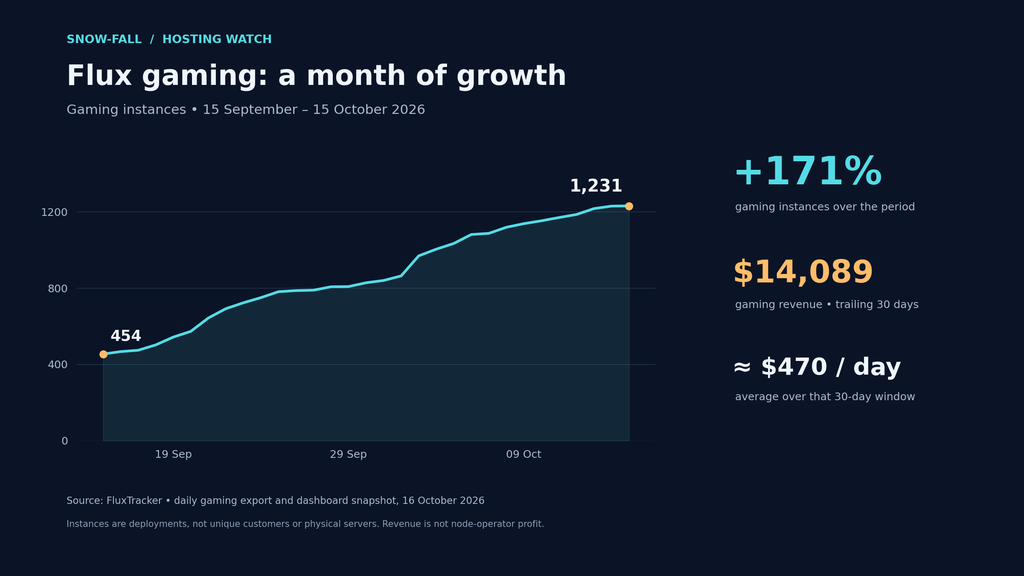
FluxTracker exports show growth from 454 to 1,231 gaming instances between September 15 and October 15, an increase of approximately 171% over that period. The October 16 snapshot then shows 1,283 instances, including Dragonwilds, Valheim and Palworld.
These instances are game deployments on the platform. They do not represent an equivalent number of physical machines or distinct customers.
The dashboard also reports $14,089 in gaming revenue over the past 30 days, equivalent to approximately $470 per day on average. This reflects the revenue displayed for that activity, rather than node operators’ profits.
The useful connection is between two observations: more gaming instances and revenue associated with hosting them. Together, they provide a concrete basis for tracking this use case on Flux.
The next question is whether that activity persists: does growth continue, are deployments renewed and how does revenue evolve over time? A one-month increase provides a starting point for that analysis.
We will return to this topic in a dedicated article on Flux hosting, using the available 90-day data. The aim will be to understand what is growing, at what pace and what the indicators actually measure.
Sources
• Tonyler — recap of the October 15 Cosmos Hub community call:
https://x.com/tonyler_/status/2110850669879955896
• MSB Intel (@MSBIntel) — Provenance post reposted by @cosmos; figures taken from the supplied excerpt, with further verification pending.
• FluxTracker — October 16 snapshot and historical exports:
https://fluxtracker.app.runonflux.io/