A Snow Fall Chronicle
9 October 2026 review — key developments from 1 September to 9 October.
Since the beginning of September, the networks covered in this review have moved in different directions. Cosmos Hub is refining its financial ambitions. Lava is pursuing a change in architecture. Sentinel is preparing its migration to Solana. Flux reports growth in its deployments, while Avalanche presents several integrations into existing services. Algorand is exploring AI agent payments and post-quantum accounts.
Behind this variety, one question allows us to compare these projects without focusing solely on their token prices: how does infrastructure become a service people use, and then a business capable of funding its own operation?
Announcements offer clues. Deployed products and usage data take the discussion further. But the value reaching operators, the protocol and token holders still needs to be assessed separately. That is what makes this autumn's developments worth examining.
Cosmos Hub refines its financial ambitions
Cosmos Hub is seeking to give more concrete substance to its role as a connection between traditional finance and on-chain finance.
The update published on 1 October outlines a possible approach to issuing and distributing assets through IBC, the protocol for communication between chains. Eventually, this infrastructure could support baskets, indices and vaults combining several sources of yield. Validators could take part in pricing, accounting and relaying, while ecosystem participants would handle asset selection.
These ideas are still being validated. They do not yet constitute a final roadmap or available products.
The economic work is progressing alongside them. Gauntlet's Phase 2 recommendations, still under revision in that publication, address the cost of security, incentives for sustained staking and the receipt of the Hub's future revenue. The stated aim is to reduce dependence on the issuance of new ATOM as revenue takes over. The update does not announce any definitive new rate. [1]
The challenge is to connect the two workstreams. Useful financial infrastructure needs to attract users; its fees must then have a clear place in the network's economy. Without that connection, new activity could benefit particular services without sustainably improving the Hub's funding.
Paxos and Neutron illustrate two dimensions of the Hub
A more tangible step was taken with Paxos. Proposal 1054 passed on 17 September, after which 300,740 USDC was transferred to fund ATOM integration, initial liquidity and support for Paxos's brokerage clients. The 24 September update announces the start of technical coordination.
This integration creates an additional distribution opportunity. It does not mean that ATOM is already available through every partner using Paxos's infrastructure. Integrations that actually go live will be the next indicator to watch. [2]
September also highlighted validators' operational responsibilities. Following the governance attack on Neutron on 22 September, some of the stolen funds reached Cosmos Hub in ATOM. Validators coordinated a halt, followed by a restart on Gaia v28.3.0 on 23 September. The remaining balance at the attacker's address, 1,227,121 ATOM, was moved to a recovery multisig.
The Hub was the destination chain for these funds, rather than the source of the attack. [2]
These two events illustrate different responsibilities: developing new opportunities and handling exceptional situations. Business development still requires reliable infrastructure; the ability to respond to an emergency does not remove the need to deliver products.
Lava chooses a new architectural direction
Lava raises a central question for decentralised infrastructure: must a project operate its own blockchain to provide an RPC service, meaning access to networks' data and functions?
Proposal 69, submitted on 28 September, asked whether Lava should leave its Cosmos chain to become a protocol on an EVM chain. The vote ended on 2 October and is marked as passed on the explorer consulted. It approves a direction; the choice of host chain, technical plan and tokenomics require separate decisions. Approval in principle therefore does not amount to a completed migration. [3][4]
On 2 October, the Foundation published a proposed economic redesign centred on paid usage. The proposed framework would use revenue to purchase LAVA, then allocate 70% to providers and 30% to an Assistance Fund. This model remains subject to governance.
One figure helps frame the discussion: in September, approximately 39,146 LAVA was distributed to providers from a quota of 1,375,000, with the remainder burned under the mechanism's rules. The Foundation specifies that this ratio measures neither RPC activity nor provider profitability. [5]
The issue extends beyond a change in technology. Lava is seeking to bring compensation flows closer to the service actually being sold. The model's quality will need to be judged by its customers, revenue and providers' economic conditions.
Sentinel prepares its migration with applications already in use
Sentinel is approaching its ecosystem change with significant reported activity. Its September review announces 72,252 new unique users and 5,850,347 encrypted dVPN sessions during the month. Cumulative figures reach 1,972,531 unique users and 32.58 million sessions since the beginning of 2026.
These figures, published by the official account and accessed through a public mirror of X, require careful interpretation. A session is not a paying customer; the cumulative user count is not the number of monthly active users.
In its early October communications, Sentinel also announces that its protocol has been rewritten in Rust and deployed on Solana devnet. This is a technical milestone, separate from a completed production migration. The project also announces the rollout of its new native client on Android and then iOS. [6]
Application activity gives the topic substance. But connection counts alone do not answer the economic questions: how many users pay, how many stay, and what do operators earn after covering their costs?
The migration will need to preserve the service's operation while opening up distribution opportunities. Its value will be measured through the user experience as much as through the new technical environment.
Nolus highlights predictable leveraged trading costs
Nolus brings a different angle: comparing the terms of a financial product.
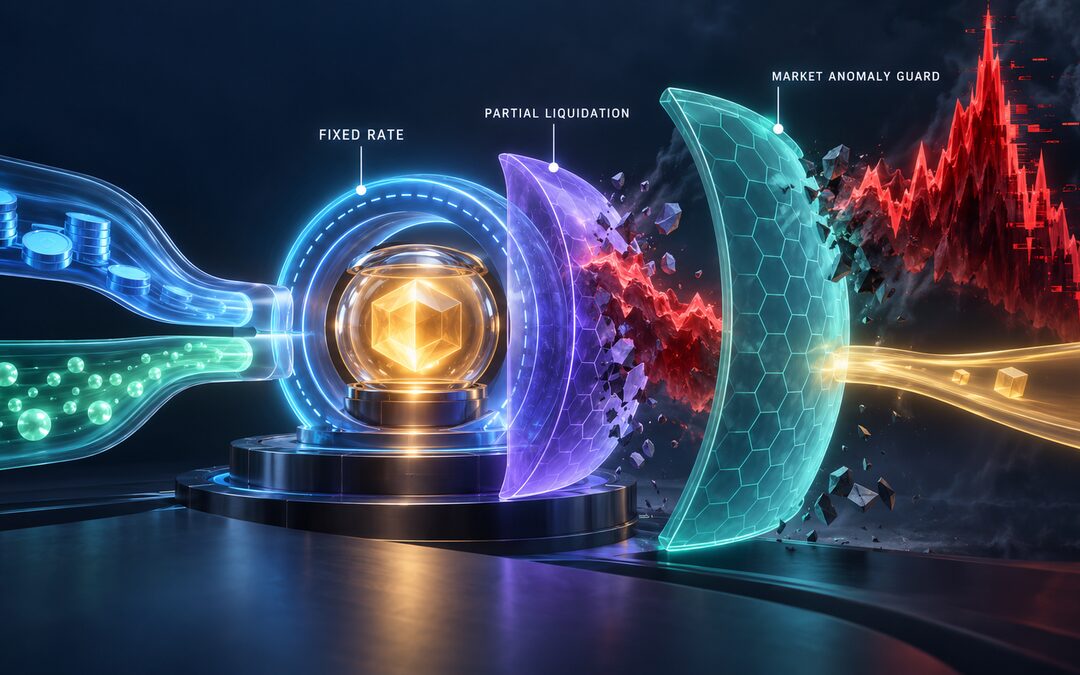
In a publication dated 23 September and updated on the 24th, the protocol compares a leveraged SOL position on Nolus, Kamino, Jupiter Lend and Save. It highlights the rate fixed when a position opens, its partial liquidations and the absence of additional liquidation fees in the scenario examined.
The publication also acknowledges a trade-off. In a quiet market, Nolus can cost more than the alternatives compared, particularly because its collateral does not generate yield. The rates observed in the comparison come from a 17 September snapshot and may change on competing platforms.
Published by Nolus itself, this exercise illustrates its commercial positioning rather than providing an independent, universal ranking of protocols. [7]
For users, the discussion is useful: the rate displayed at entry does not capture the full cost of a position. Changing interest rates, liquidation thresholds and fees applied under pressure also matter.
This communication shows how Nolus intends to differentiate itself. On its own, it does not demonstrate growth in borrowing, users or revenue since September.

Flux reports growth in its deployments
Flux provides a direct comparison between 3 September and 2 October. Its census records growth in registered applications and node numbers.
| Indicator | 3 September | 2 October | Calculated change |
|---|---|---|---|
| Registered applications | 1,195 | 1,913 | +60.1% |
| Requested instances | 7,486 | 8,509 | +13.7% |
| Nodes | 6,489 | 6,801 | +4.8% |
| Stratus nodes | 1,627 | 1,780 | +9.4% |
Game servers account for a substantial share: 865 applications, or approximately 45% of the registry. Flux also reports 945 private applications, including 614 game servers. All private deployments should therefore not be equated with enterprise customers.
Flux publishes these data from a census of its public interfaces. They measure deployments and capacity, rather than directly measuring turnover or the number of distinct customers. [8]
The economic appeal of hosting is easy to understand: an application needs resources, and its owner can pay to obtain them. Registry growth is a signal worth following. Application lifetimes, resource consumption and recurring revenue will help assess how robust that growth is.
The Ergo bridge highlights integration risks
Another event affected Flux in September. According to the account published on 23 September, the bridge reserves on Ergo were taken on 21 September through the storage rent mechanism, which applies to certain funds left unmoved for four years.
Flux states that the reserve was returned in full within 24 hours and that user balances eligible under the snapshot are honoured one-for-one in native FLUX. The team also announces the permanent closure of the Ergo bridge.
It would therefore be incorrect to describe this episode as users losing 415 million native FLUX. The account describes an incident affecting the bridge reserve on Ergo, its custody mechanisms and their management. [9]
The episode highlights a practical challenge of interoperability: a remote chain's rules continue to apply to assets deposited there. Integrations need maintenance over time, even when funds appear simply to be waiting in a reserve.
Avalanche integrates its technology into existing services
Avalanche presented several use cases during September.
On 1 September, its publication about Ethena Pay describes a financial application using Avalanche for USDe transfers, payments and settlement. The availability announced at that point covers iOS in more than 50 countries; the European Union and the United States are planned for a later stage. [10]
On 14 September, Avalanche announces the use of a dedicated L1 for the Digital Vault within UAEPASS, the United Arab Emirates' identity platform. The cited 12.5 million users belong to the identity platform, rather than representing a count of active blockchain users. [11]
On 24 September, another publication presents six US university athletics programmes that have launched loyalty experiences through Uptop on Avalanche. [12]
These examples illustrate usage in which blockchain can remain unobtrusive to the public. Users want to make a payment, share a document or receive a reward. The infrastructure's relevance then depends on that service working properly.
The benefit to the network and its token must nevertheless be measured separately. The reach of a brand or platform does not automatically translate into an equivalent number of on-chain users or equivalent demand for AVAX.
Helicon changes staking conditions
On the technical side, Helicon activated on Avalanche mainnet on 22 September.
The upgrade introduces automatic renewal of validators' own stake and reduces the minimum validation period from two weeks to 48 hours. The uptime threshold required for rewards rises to 90% for the relevant new periods. Delegations do not benefit from automatic renewal.
Helicon also changes C-Chain execution, the minimum gas price and the reward curve, one component of which adjusts gradually over 90 days. [13]
These changes directly affect the network's operating conditions. They are intended to simplify some operations and strengthen performance requirements. Their impact will be judged through service reliability and the costs actually borne by participants.
Algorand explores AI agent payments
On 9 September, Algorand announced the appointment of William Herkelrath as CEO, with an emphasis on institutional adoption and post-quantum resilience. [14]
On 14 September, a publication presents applications using x402 to pay for services on a usage basis. Examples include analysis, coding tools and rules governing AI agents' spending. These are early experiments; some projects use testnet. [15]
The idea is economically interesting: software can purchase a specific capability when it needs it. To become a sustainable market, these services will need to solve problems for which users are willing to pay regularly.
On 17 September, Pera Wallet and Algorand also announce that post-quantum transactions have passed the one-million mark. The publication specifies that a substantial share comes from a commemorative NFT campaign encouraging transactions. This technical milestone should therefore not be interpreted as one million spontaneous commercial payments. [16]
Algorand is pursuing two complementary areas: new ways to pay for digital services and an evolution in account security. Their adoption will need to be measured beyond demonstrations and participation campaigns.
Measuring the value created and where it goes
This autumn shows projects working on concrete economic questions. The Hub is seeking financial products capable of generating fees. Lava is reviewing the architecture and compensation model of its infrastructure. Sentinel is preparing a change of environment with applications already in use. Nolus is advocating a cost model. Flux reports additional deployments. Avalanche presents integrated services, and Algorand experiments with programmable payments.
These trajectories cannot be compared using a single figure. To follow them, four elements must be distinguished: service usage, paying customers, protocol revenue and the share of that value reaching the token.
A network can succeed technically without having found its market. A service can attract users without covering its costs. A company can make money using a blockchain without that success benefiting its native asset in the same proportions.
This is where the coming months will be decisive. Delivered products, retained customers and recurring revenue will allow these ambitions to be assessed. For this review, the question remains the one that connects all the others: who uses the service, who pays, and where does that money go?
Sources
- Cosmos Hub Weekly Update of 1 October 2026
- Cosmos Hub Weekly Update of 24 September 2026
- Lava Proposal 69 and voting result
- Scope of Lava's vote and subsequent decisions
- Lava Reopening Tokenomics of 2 October 2026
- Sentinel account posts reproduced on a public mirror of X — September review and early October announcements; figures reported by the project.
- Nolus Kamino vs Jupiter vs Nolus of 23 September 2026
- Flux in Numbers September–October 2026 comparison
- Flux account of the Ergo bridge incident of 23 September 2026
- Avalanche and Ethena Pay of 1 September 2026
- Avalanche and UAEPASS of 14 September 2026
- Avalanche Signing Day of 24 September 2026
- Avalanche Helicon and mainnet activation
- Algorand appointment of William Herkelrath of 9 September 2026
- Algorand x402 applications of 14 September 2026
- Pera Wallet post-quantum transactions of 17 September 2026