In recent days, a number of signals coming from the Flux ecosystem may deserve more attention than they are currently receiving. Not because they are spectacular or immediately revealing, but precisely because they reflect a gradual, almost quiet dynamic that could, over time, begin to outline something more structured.
The gaming marketplace, in particular, is evolving. New games are being added on a regular basis, deployments are becoming more accessible, and the overall experience is starting to look less like a technical showcase and more like a functional building block that is steadily maturing.
(https://cloud.runonflux.com/marketplace/games/)
At first glance, the interpretation remains relatively straightforward: Flux is providing infrastructure to deploy game servers. Nothing more, nothing less. We are still far from a distribution platform comparable to Steam, and nothing at this stage suggests an immediate intention to position itself directly in that space.
And yet, some elements slightly complicate this otherwise simple reading.
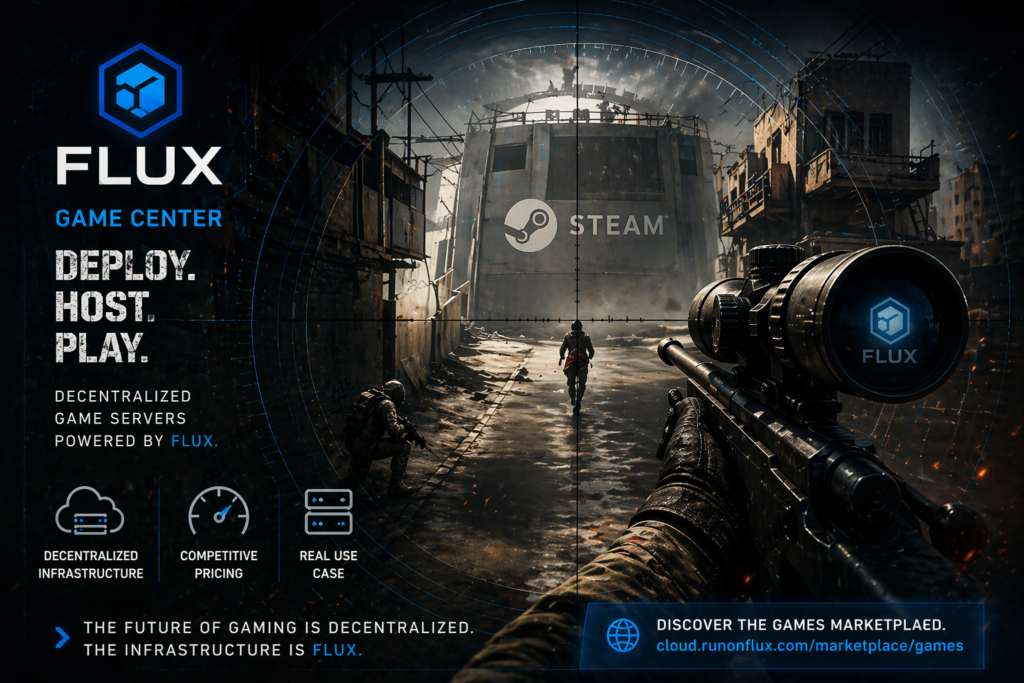
A recent visual shared by Daniel Keller, referencing Steam in a rather deliberate and almost confrontational manner, raises questions. Is this merely a marketing gesture designed to capture attention, or a more subtle signal pointing toward a broader ambition that is still taking shape?
At this stage, it would be excessive to draw firm conclusions. No major partnership has been announced, no clear institutional player appears to be driving these deployments, and there is no tangible evidence of a single large client supporting this activity. The idea of a “hidden major player” therefore remains, for now, unconvincing.
Perhaps the question needs to be reframed.
Because when observing the marketplace more closely, what emerges is not the footprint of a single actor, but rather the gradual construction of a use case. Slowly, yes, but coherently. Each new game added is not an announcement in itself, but another iteration. Each improvement in deployment does not redefine the model, but makes it more usable, more concrete, and closer to something that could scale.
Another element is worth noting.
The pricing of these deployments appears particularly competitive, which turns this offer into something genuinely accessible, and therefore potentially used. This accessibility is not trivial: it allows communities, developers, and smaller groups to engage with decentralized infrastructure without significant friction.
This is where the link with the network’s economic layer becomes relevant.
Each deployed server consumes resources within the Flux network, and therefore indirectly contributes to demand around the Flux token. This should not be reduced to a simplistic “burn mechanism” that would mechanically support price, but rather understood as a more subtle economic flow, where usage progressively creates a form of absorption.
At this stage, the scale remains modest in the context of the broader market, but the underlying dynamic is meaningful. While many projects struggle to connect their token to tangible utility, Flux is beginning, through initiatives like this, to establish a link between infrastructure, product, and economic activity.
In that sense, Flux may not be trying to become a new Steam, nor to partner with one, but rather to position itself at a more fundamental layer: infrastructure. An invisible layer, perhaps, but one that is essential, and upon which more complex experiences could eventually be built.
Nothing guarantees that this direction is fully defined, nor that it will succeed. But the signals, when considered together, suggest at least a trajectory.
And in an ecosystem where announcements are often loud but short-lived, this kind of quiet, methodical progress may ultimately prove to be one of the more meaningful developments to watch.
Snow-Fall, for its part, remains directly involved in supporting this network. Our infrastructure already contributes to its operation, and it is likely that, in the near future, some of our nodes will also host these types of services, particularly in the gaming space. A natural evolution, in line with the emerging use cases.